>
Elopiformes (Tarpons and tenpounders) >
Megalopidae (Tarpons)
Etymology: Megalops: Greek, megas, megalos = great + Greek, ops = appearance (Ref. 45335).
Milieu: milieu / Klimaatzone / Diepte / verspreidingsgebied
Ecologie
marien; zoet water; brak water benthopelagisch; katadroom (Ref. 138274); diepte 1 - 50 m (Ref. 86942). Tropical; 34°N - 37°S, 16°E - 130°W
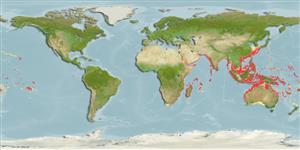
Indo-Pacific: Persian Gulf (Ref. 68964), Red Sea and Natal, South Africa (Ref. 3969) to the Society Islands, north to southern Korea, south to the Arafura Sea (Ref. 9819) and New South Wales. Restricted to high islands (Palau, Caroline and Mariana islands) in Micronesia. Reported as far inland as the lower Shire in Malawi and the Save-Runde junction in Zimbabwe (Ref. 7248, 52193). Widespread in the Lower Zambezi River channels up to Marromeu and in the Micelo River up to Malingapanzi (Ref. 39494). South China Sea, Taiwan Strait, and East China Sea(Ref.33302).
Lengte bij maturiteit / Grootte / Gewicht / Leeftijd
Maturiteit: Lm ?, range 25 - ? cm
Max length : 150 cm TL mannelijk / geslacht onbekend; (Ref. 1479); common length : 30.0 cm SL mannelijk / geslacht onbekend; (Ref. 7017); common length :45.5 cm SL (female); max. gepubliceerd gewicht: 18.0 kg (Ref. 13337); max. gerapporteerde leeftijd: 44 Jaren (Ref. 72487)
Dorsale stekels (totaal) : 0; Dorsale zachte stralen (totaal) : 16 - 21; Anale stekels: 0; Anale zachte stralen: 23 - 31.
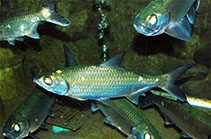
Body shape (shape guide): elongated; Cross section: compressed.
Obligate air-breathing (Ref. 126274); Adults are generally found at sea, but young inhabit river mouths, inner bays, and mangrove forests. In freshwater, they occur in rivers, lagoons, lakes, and swampy backwaters (Ref. 2847, 44894). Tolerate a wide pH range (5.2-9.1) (Ref. 44894) and salinities from 0 to 100. Mainly diurnal (Ref. 7017). Predaceous, feeding mainly on fishes and crustaceans (Ref. 5213). Breed offshore, possibly throughout the year. Larvae are transparent and resemble larval eels (Ref. 13337), but with a forked tail (Ref. 167). Juveniles commonly enter freshwater (Ref. 44894, 48635) in clear or turbid water (Ref. 44894). Known to breath air, rising regularly to the surface to do so. Cultured in ponds, the fry being sourced from the coasts (Ref. 7050). Popular angling fish (Ref. 3969). Edible but not esteemed (Ref. 3969). Caught by gill nets, seines, and trawls, and by hook-and-line; marketed fresh and dried salted (Ref. 10982).
Whitehead, P.J.P., 1984. Megalopidae. In W. Fischer and G. Bianchi (eds.) FAO species identification sheets for fishery purposes. Western Indian Ocean fishing area 51. Vol. 3. [pag. var.]. FAO, Rome. (Ref. 3463)
Status op de Rode Lijst van het IUCN (Ref. 130435: Version 2025-2 (Global))
Gevaar voor de mens
Harmless
Gebruik door de mens
Visserij: van minder commercieel belang; Aquacultuur: commercieel; sportvis: ja
Tools
Speciale rapporten
Download XML
Internetbronnen
Schattingen op basis van modellen
Gewenste temperatuur (Ref.
123201): 19.8 - 27.6, mean 24.4 °C (based on 501 cells).
Fylogenetische diversiteitsindex (Ref.
82804): PD
50 = 1.0020 [Uniqueness, from 0.5 = low to 2.0 = high].
Bayesian length-weight: a=0.00741 (0.00535 - 0.01027), b=3.07 (2.98 - 3.16), in cm total length, based on LWR estimates for this species (Ref.
93245).
Trofisch niveau (Ref.
69278): 3.5 ±0.1 se; based on diet studies.
Weerstandsvermogen (Ref.
120179): Gemiddeld, minimale populatieverdubbelingstijd 1,4-4,4 jaar (Assuming tm<=4).
Prior r = 0.57, 95% CL = 0.37 - 0.85, Based on 2 data-limited stock assessments.
Kwetsbaarheid van de visserij (Ref.
59153): Very high vulnerability (90 of 100).
🛈
Kwetsbaarheid voor het klimaat (Ref.
125649): High to very high vulnerability (75 of 100).
🛈
Voedingsstoffen (Ref.
124155): Calcium = 44.8 [26.3, 77.6] mg/100g; Iron = 0.672 [0.410, 1.048] mg/100g; Protein = 17.1 [14.3, 19.7] %; Omega3 = 0.217 [0.122, 0.396] g/100g; Selenium = 71.1 [41.2, 135.1] μg/100g; VitaminA = 15 [6, 33] μg/100g; Zinc = 1.06 [0.78, 1.46] mg/100g (wet weight);