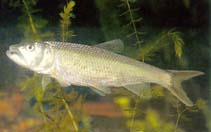
Environnement : milieu / zone climatique / profondeur / gamme de distribution
Écologie
; eau douce benthopélagique. Temperate; 10°C - 22°C (Ref. 2059); 54°N - 32°N, 114°E - 141°E
Asia: Eastern Siberia to northern Korea and China. Also in Japan.
Longueur à la première maturité / Taille / Poids / Âge
Maturité: Lm 10.0 range ? - ? cm
Max length : 44.4 cm TL mâle / non sexé; (Ref. 126870); common length : 12.4 cm SL mâle / non sexé; (Ref. 35840); poids max. publié: 722.10 g (Ref. 126870)
Description synthétique
Clés d'identification | Morphologie | Morphométrie
Rayons mous dorsaux (Total) : 10; Rayons mous anaux: 12; Vertèbres: 43. Enlarged anal fin with conspicuous rays.
Cycle de vie et comportement reproducteur
Maturité | Reproduction | Frai | Œufs | Fécondité | Larves
Spawn from June to August. Eggs are scattered over sand or gravel.
Masuda, H., K. Amaoka, C. Araga, T. Uyeno and T. Yoshino, 1984. The fishes of the Japanese Archipelago. Vol. 1. Tokai University Press, Tokyo, Japan. 437 p. (text). (Ref. 559)
Statut dans la liste rouge de l'IUCN (Ref. 130435: Version 2025-2 (Global))
Menace pour l'homme
Potential pest (Ref. 1739)
Utilisations par l'homme
Outils
Articles particuliers
Télécharger en XML
Sources Internet
Estimations basées sur des modèles
Indice de diversité phylogénétique (Réf.
82804): PD
50 = 0.5000 [Uniqueness, from 0.5 = low to 2.0 = high].
Bayesian length-weight: a=0.00617 (0.00541 - 0.00703), b=3.07 (3.03 - 3.11), in cm total length, based on LWR estimates for this species (Ref.
93245).
Niveau trophique (Réf.
69278): 3.9 ±0.64 se; based on food items.
Résilience (Réf.
120179): Milieu, temps minimum de doublement de population : 1,4 à 4,4 années (Preliminary K or Fecundity.).
Vulnérabilité de la pêche (Ref.
59153): Low to moderate vulnerability (34 of 100).
🛈