>
Callionymiformes (Dragonets) >
Callionymidae (Dragonets)
Etymology: Callionymus: Greek, kallion, comparative of kallos = beautiful + Greek, onyma = name; with a better name.
More on author: Linnaeus.
Environnement : milieu / zone climatique / profondeur / gamme de distribution
Écologie
marin démersal; profondeur 1 - 440 m (Ref. 5968), usually 5 - 30 m (Ref. 27115). Temperate; 16°C - 20°C (Ref. 27115); 66°N - 16°N, 42°W - 42°E
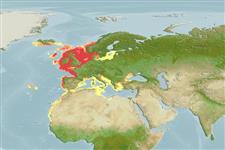
Eastern Atlantic: southern Iceland and Norway south to Mauritania, including the northern Mediterranean, Gibraltar, and Algeria, western Black Sea, Aegean and Adriatic Sea, Azores and the Canary Islands.
Longueur à la première maturité / Taille / Poids / Âge
Maturité: Lm 17.4 range ? - ? cm
Max length : 30.5 cm TL mâle / non sexé; (Ref. 59122); 25.0 cm TL (female); common length : 15.0 cm TL mâle / non sexé; (Ref. 3397); âge max. reporté: 7 années (Ref. 72462)
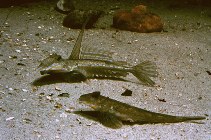
Épines dorsales (Total) : 4; Rayons mous dorsaux (Total) : 8 - 10; Rayons mous anaux: 9. Gill opening dorsal. Usually antrorse (forward-pointing) tip at base of preopercular spine. Rays of second dorsal unbranched except for the last, which is divided at base (Ref. 232). Snout length 2-3 times the diameter of the eye (Ref. 35388).
Body shape (shape guide): elongated.
Occurs on sand and muddy bottoms from sublittoral to 200 m (Ref. 6444) and to 400 m or more (Ref. 9900). Feeds on small invertebrates, mainly worms and crustaceans. Territorial, males aggressive with each other. Complex courtship behavior consists of 4 phases: courtship, pairing, ascending, releasing eggs and milt. Pelagic eggs and larvae (Ref. 5968). Minimum depth reported from Ref. 27115. Neither opercular spine gland nor anterolateral glandular groove with venom gland is present (Ref. 57406).
Complex courtship behavior with 4 phases: courtship, pairing, ascending, releasing eggs and milt (Ref. 5968).
Davis, W.P and R. Fricke, 1990. Callionymidae. p. 921-924. In J.C. Quero, J.C. Hureau, C. Karrer, A. Post and L. Saldanha (eds.) Check-list of the fishes of the eastern tropical Atlantic (CLOFETA). JNICT, Lisbon, SEI, Paris; and UNESCO, Paris. Vol. 2. (Ref. 6941)
Statut dans la liste rouge de l'IUCN (Ref. 130435: Version 2025-2 (Global))
Utilisations par l'homme
Pêcheries: intérêt commercial mineur; Aquarium: Aquariums publics
Outils
Articles particuliers
Télécharger en XML
Sources Internet
Estimations basées sur des modèles
Température préférée (Réf.
123201): 11.7 - 19.5, mean 13.3 °C (based on 92 cells).
Indice de diversité phylogénétique (Réf.
82804): PD
50 = 0.5000 [Uniqueness, from 0.5 = low to 2.0 = high].
Bayesian length-weight: a=0.01072 (0.00893 - 0.01286), b=2.78 (2.73 - 2.83), in cm total length, based on LWR estimates for this species (Ref.
93245).
Niveau trophique (Réf.
69278): 3.4 ±0.5 se; based on diet studies.
Generation time: 2.6 ( na - na) years. Estimated as median ln(3)/K based on 2
growth studies.
Résilience (Réf.
120179): Milieu, temps minimum de doublement de population : 1,4 à 4,4 années (K=0.43-0.47; tmax=6).
Vulnérabilité de la pêche (Ref.
59153): Low to moderate vulnerability (29 of 100).
🛈
Nutriments (Ref.
124155): Calcium = 54.2 [31.1, 99.0] mg/100g; Iron = 0.386 [0.218, 0.684] mg/100g; Protein = 17.9 [17.0, 18.8] %; Omega3 = 0.478 [0.259, 0.840] g/100g; Selenium = 18.5 [9.3, 38.6] μg/100g; VitaminA = 13.4 [3.7, 47.5] μg/100g; Zinc = 0.617 [0.442, 0.885] mg/100g (wet weight);