>
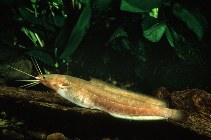
Siluriformes (Catfishes) >
Clariidae (Airbreathing catfishes)
Etymology: Clarias: Greek, chlaros = lively, in reference to the ability of the fish to live for a long time out of water.
More on author: Boulenger.
Meio ambiente: milieu / Zona climática / intervalo de profundidade / faixa de distribuição
Ecologia
; Água doce demersal. Tropical; 22°C - 28°C (Ref. 12468); 2°N - 12°S
Africa: Lake Victoria, Edward, George, small lakes of Uganda, Lake Kivu, smaller lakes of Rwanda, Lake Tanganyika, in Malawi, Kagera, Malagarazi and Ruzizi Rivers (Ref. 248). Also in Lake Rukwa (Ref. 27292) and in Luapula and Lualaba River drainages (Congo River basin) (Ref. 248). Present in Cunene, Okavango, upper Zambezi, and Kafue systems (Ref. 7248).
Tamanho / Peso / Idade
Maturidade: Lm ? range ? - ? cm
Max length : 32.0 cm TL macho/indeterminado; (Ref. 3820)
Espinhos dorsais (total) : 0; Raios dorsais (total) : 67 - 79; Raios anais : 53 - 67; Vértebras: 55 - 58. Pectoral fin spine with serrations on the inner and upward directed on the outer side (Ref. 34290). Head oval to rectangular dorsally; snout broadly rounded; eyes more laterally located. Frontal fontanelle intermediate between `knife-shaped' and `sole-shaped'; occipital fontanelle long and oval-shaped. Supraorbital and `dermosphenotic' bones generally joined above 150 mm SL and more dorsally placed. Tooth plates relatively broad. Pectoral spine relatively short; its outer side strongly serrated over entire length. Gill rakers short and far apart. Openings of secondary sensory canals regularly arranged on flanks.
Body shape (shape guide): elongated; Cross section: circular.
Facultative air-breathing (Ref. 126274); Occurs in marginal water-lily and papyrus swamps as well as in marginal weed beds; abundant in high mountain streams and torrents and on the bottom among stones; not found in any situation lower than about 915 m above sea level nor in water of a higher temperature than 18 °C (Ref. 248). In the Rukwa and Malawi drainage they are sometimes found in very cold upland streams (Ref. 78218). These fishes are omnivores, feeding on insect larvae and sometimes also fishes (Ref. 78218).
Ciclo de vida ou comportamento de acasalamento
Maturidade | Reprodução | Desova | Ovos | Fecundidade | Larvas
Teugels, G.G., 1986. A systematic revision of the African species of the genus Clarias (Pisces; Clariidae). Ann. Mus. R. Afr. Centr., Sci. Zool., 247:199 p. (Ref. 248)
Status na Lista Vermelha da UICN (Ref. 130435: Version 2025-2 (Global))
Ameaça para os humanos
Harmless
Uso pelos humanos
Pescarias: espécies comerciais
Ferramentas
Relatórios especiais
Baixar XML
Fontes da internet
Estimativas baseadas em modelos
Índice de diversidade filogenética (Ref.
82804): PD
50 = 0.5000 [Uniqueness, from 0.5 = low to 2.0 = high].
Bayesian length-weight: a=0.00776 (0.00372 - 0.01620), b=2.96 (2.79 - 3.13), in cm total length, based on LWR estimates for this Genus-body shape (Ref.
93245).
Nível Trófico (Ref.
69278): 3.3 ±0.45 se; based on food items.
Resiliência (Ref.
120179): Elevada, tempo mínimo de duplicação da população menor que 15 meses (Preliminary K or Fecundity.).
Vulnerabilidade da pesca (Ref.
59153): Low vulnerability (22 of 100).
🛈