>
Lophiiformes (Anglerfishes) >
Caulophrynidae (Fanfins)
Etymology: Caulophryne: Greek, 'kaulos' or 'caulis' = stem + Greek, 'phryne' = toad (according to Goode and Bean (1896): "a 'phryne'-like fish with the cephalic tentacle supported on a stemlike base") ( Ref. 86949); jordani: jordani named for David Starr Jordan, possibly America's ichthyologist (Ref. 4525).
Eponymy: Dr David Starr Jordan (1851–1931) was a leading American ichthyologist, physician, educator, peace activist and believer in eugenics; moreover, he was founding President of Stanford University. [...] (Ref. 128868), visit book page.
More on authors: Goode & Bean.
Entorno: milieu / zona climática / rango de profundidad / gama de distribución
Ecología
marino batipelágico; rango de profundidad 100 - 1510 m (Ref. 5951). Deep-water
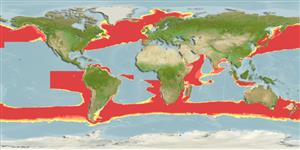
Circumglobal.
Tamaño / Peso / Edad
Madurez: Lm ? range ? - ? cm
Max length : 11.0 cm TL macho / no sexado; (Ref. 7300); 20.0 cm TL (female)
Descripción breve
Claves de identificación | Morfología | Morfometría
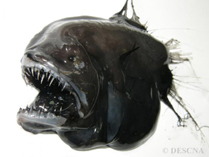
Espinas dorsales (total) : 0; Radios blandos dorsales (total) : 16; Espinas anales: 0; Radios blandos anales: 17. Illicium pigmented except near esca, with 5-14 elongate translucent filaments along entire length, al but distal-most arising from posterior margin (Ref. 13608); length of illicium 16.8-36.8%SL; stem of illicium pigmented except near esca; esca with an elongate filamentous anterolateral appendage; 2 distal appendages, each bearing numerous filaments, anterior most short and stout, opaque along posterior margin, posterior most considerably more slender; posterolateral appendage bearing numerous short filaments and with palmate opaque distal tip; dorsal fin rays 16-19; anal fin rays 14-18; pectoral fin rays 16-19; upper jaw teeth 17-39; lower jaw teeth 12-26; teeth on vomer 2-5 (Ref. 86949).
Body shape (shape guide): short and / or deep.
Bathy- and mesopelagic (Ref. 75154). Males parasitic on the females (Ref. 559).
Ciclo vital y comportamiento de apareamiento
Madurez | Reproducción | Puesta | Huevos | Fecundidad | Larva
Paxton, J.R., D.F. Hoese, G.R. Allen and J.E. Hanley, 1989. Pisces. Petromyzontidae to Carangidae. Zoological Catalogue of Australia, Vol. 7. Australian Government Publishing Service, Canberra, 665 p. (Ref. 7300)
Situación en la Lista Roja de la UICN (Ref. 130435: Version 2025-2 (Global))
Amenaza para el ser humano
Harmless
Usos humanos
Pesquerías: bycatch
Herramientas
Informes especiales
Descargar XML
Fuentes de Internet
Estimaciones basadas en modelos
Temperatura preferida (Referencia
123201): 1.1 - 13.7, mean 7.1 °C (based on 1411 cells).
Índice de diversidad filogenética (Referencia
82804): PD
50 = 0.5938 [Uniqueness, from 0.5 = low to 2.0 = high].
Bayesian length-weight: a=0.01995 (0.00906 - 0.04395), b=3.01 (2.83 - 3.19), in cm total length, based on all LWR estimates for this body shape (Ref.
93245).
Nivel trófico (Referencia
69278): 3.9 ±0.5 se; based on size and trophs of closest relatives
Vulnerabilidad pesquera (Ref.
59153): Low vulnerability (10 of 100).
🛈