>
Lophiiformes (Anglerfishes) >
Gigantactinidae (Whipnose anglers)
Etymology: Gigantactis: Greek, 'gigas' or 'gigantos' = gigantic + Greek, 'aktis' = ray (referring to the unusually long first dorsal-fin spine that functions as a lure in this genus) (Ref. 86949).
Eponymy: Dr Gerhard Krefft (1912–1993) was a German ichthyologist and herpetologist whose great uncle was Johann Ludwig Gerard Krefft (below). [...] (Ref. 128868), visit book page.
Umwelt: Milieu / Klimazone / Tiefenbereich / Verbreitungsgebiet
Ökologie
seewasser bathypelagisch; tiefenbereich 0 - 2000 m (Ref. 559). Deep-water
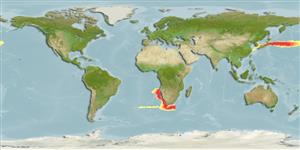
Southeast Atlantic: off Cape Town, South Africa. Northwest Pacific: Japan.
Größe / Gewicht / Alter
Geschlechtsreife: Lm ? range ? - ? cm
Max length : 25.2 cm SL (female)
Kurzbeschreibung
Bestimmungsschlüssel | Morphologie | Morphometrie
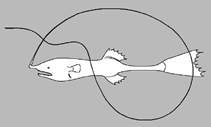
Rückenflossenweichstrahlen (insgesamt) : 7; Afterflossenweichstrahlen: 6. Metamorphosed females distinguished by the following characteristics: length of illicium less than 120% SL; distal escal prolongation with spinules at base and several unpigmented, digitiform filaments on lateral margins; absence of escal papillae; posteromedial papilla at base of escal bulb and second on illicium below bulb; absence of proximal escal filaments; dentary teeth relatively long (longest 2.6-5.2% SL), in four or five longitudinal series; rays of caudal fin less than 30% SL (Ref. 86949).
Minimum depth from Ref. 58018.
Lebenszyklus und Paarungsverhalten
Geschlechtsreife | Fortpflanzung | Ablaichen | Eier | Fruchtbarkeit | Larven
Masuda, H., K. Amaoka, C. Araga, T. Uyeno and T. Yoshino, 1984. The fishes of the Japanese Archipelago. Vol. 1. Tokai University Press, Tokyo, Japan. 437 p. (text). (Ref. 559)
IUCN Rote Liste Status (Ref. 130435: Version 2025-2 (Global))
Bedrohung für Menschen
Harmless
Nutzung durch Menschen
Fischereien: nicht kommerziell
Tools
Zusatzinformationen
Download XML
Internet Quellen
Schätzungen auf der Grundlage von Modellen
Bevorzugte Temperatur (Ref.
123201): 0.3 - 10.8, mean 1.8 °C (based on 41 cells).
Phylogenetischer Diversitätsindex (Ref.
82804): PD
50 = 0.5000 [Uniqueness, from 0.5 = low to 2.0 = high].
Bayesian length-weight: a=0.01995 (0.00906 - 0.04395), b=3.01 (2.83 - 3.19), in cm total length, based on all LWR estimates for this body shape (Ref.
93245).
Trophische Ebene (Ref.
69278): 4.1 ±0.5 se; based on size and trophs of closest relatives
Anfälligkeit der Fischerei (Ref.
59153): Low vulnerability (21 of 100).
🛈