Umwelt: Milieu / Klimazone / Tiefenbereich / Verbreitungsgebiet
Ökologie
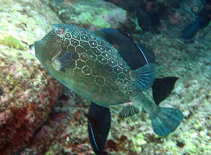
seewasser demersal; tiefenbereich 3 - 25 m (Ref. 5288), usually ? - 10 m (Ref. 86997). Subtropical
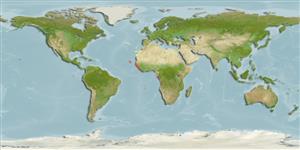
Eastern Atlantic: Azores, St. Helena and Ascension islands, Ghana, and Angola. Reported from Sao Tome Island (Ref. 34088).
Größe / Gewicht / Alter
Geschlechtsreife: Lm ? range ? - ? cm
Max length : 50.0 cm TL Männchen/unbestimmt; (Ref. 11227)
Found over rocks, rubble and sand (Ref. 5288), mainly around islands (Ref. 11227).
Lebenszyklus und Paarungsverhalten
Geschlechtsreife | Fortpflanzung | Ablaichen | Eier | Fruchtbarkeit | Larven
Duron, M. and J.C. Quéro, 1990. Ostraciontidae. p. 1067-1068. In J.C. Quero, J.C. Hureau, C. Karrer, A. Post and L. Saldanha (eds.) Check-list of the fishes of the eastern tropical Atlantic (CLOFETA). JNICT, Lisbon; SEI, Paris; and UNESCO, Paris. Vol. 2. (Ref. 11227)
IUCN Rote Liste Status (Ref. 130435: Version 2025-2 (Global))
Bedrohung für Menschen
Harmless
Nutzung durch Menschen
Tools
Zusatzinformationen
Download XML
Internet Quellen
Schätzungen auf der Grundlage von Modellen
Bevorzugte Temperatur (Ref.
123201): 21.5 - 28, mean 26.2 °C (based on 235 cells).
Phylogenetischer Diversitätsindex (Ref.
82804): PD
50 = 0.5625 [Uniqueness, from 0.5 = low to 2.0 = high].
Bayesian length-weight: a=0.03715 (0.01854 - 0.07445), b=2.80 (2.61 - 2.99), in cm total length, based on LWR estimates for this (Sub)family-body shape (Ref.
93245).
Trophische Ebene (Ref.
69278): 2.4 ±0.1 se; based on size and trophs of closest relatives
Widerstandsfähigkeit (Ref.
120179): hoch, Verdopplung der Population dauert weniger als 15 Monate. (Fec assumed to be > 10,000).
Anfälligkeit der Fischerei (Ref.
59153): Moderate vulnerability (40 of 100).
🛈