Entorno: milieu / zona climática / rango de profundidad / gama de distribución
Ecología
marino demersal; rango de profundidad 176 - 600 m (Ref. 11356), usually 300 - 600 m (Ref. 116586). Subtropical
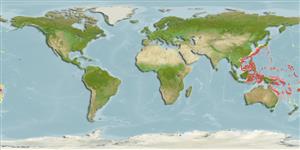
Western Pacific: from Taiwan and the Philippines to northwestern Australia and Vanuatu where it is common but rare off Japan.
Tamaño / Peso / Edad
Madurez: Lm ? range ? - ? cm
Max length : 7.5 cm SL macho / no sexado; (Ref. 11356); 8.1 cm SL (female)
Descripción breve
Claves de identificación | Morfología | Morfometría
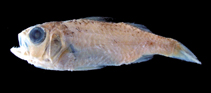
Vértebra: 13 - 16. This small deep-bodied species is distinguished by the following characters: convex dorsal head profile; second spine of first dorsal fin, spine of second dorsal fin, second spine of anal fin and spine of pelvic fin are serrated; A II + 7; pectoral-fin rays 14-16, pectoral length 20.3-26.5% SL; gill rakers 13-16; pseudobranchial filaments (13) 16-21; first anal-fin pterygiophore is long and straight, with broad tip and hollow; palatines and ectopterygoids are moderately wide, with 1-2 rows of denticles; orbital diameter 11.7-13.6% SL; posterior edge of maxillary plate is slightly concave; without longitudinal ridges on preopercular lobe; otolith very compressed (OL:OH = 1.35-1.4) (Ref. 116586).
Body shape (shape guide): fusiform / normal; Cross section: compressed.
Found on the continental slope (Ref. 75154).
Ciclo vital y comportamiento de apareamiento
Madurez | Reproducción | Puesta | Huevos | Fecundidad | Larva
Schwarzhans, W.W. and A.M. Prokofiev, 2017. Reappraisal of Synagrops, Günther, 1887 with rehabilitation and revision of Parascombrops Alcock, 1889 including description of seven new species and two new genera (Perciformes: Acropomatidae). Zootaxa 4260(1):1-74. (Ref. 116586)
Situación en la Lista Roja de la UICN (Ref. 130435: Version 2025-2 (Global))
Amenaza para el ser humano
Harmless
Usos humanos
Herramientas
Informes especiales
Descargar XML
Fuentes de Internet
Estimaciones basadas en modelos
Temperatura preferida (Referencia
123201): 11.1 - 18.8, mean 13.5 °C (based on 93 cells).
Índice de diversidad filogenética (Referencia
82804): PD
50 = 0.5001 [Uniqueness, from 0.5 = low to 2.0 = high].
Bayesian length-weight: a=0.00977 (0.00432 - 0.02212), b=3.01 (2.82 - 3.20), in cm total length, based on LWR estimates for this (Sub)family-body shape (Ref.
93245).
Nivel trófico (Referencia
69278): 3.4 ±0.5 se; based on size and trophs of closest relatives
Vulnerabilidad pesquera (Ref.
59153): Low vulnerability (10 of 100).
🛈