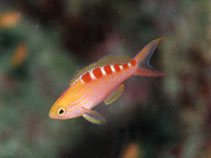
Classification / Noms
Noms communs | Synonymes | Catalog of Fishes(Genre, Espèce) | ITIS | CoL | WoRMS | Cloffa
>
Perciformes/Serranoidei (Groupers) >
Anthiadidae (Fairy basslets or Streamer basses)
Etymology: Pyronotanthias: Name from Greek πυρ, fire, νοτος, back, and Anthias. It ; referring to the characteristic red blotches or
stripes on the upper caudal peduncle and beneath the posterior part of the dorsal fin of the included species.
is masculine.
Environnement : milieu / zone climatique / profondeur / gamme de distribution
Écologie
marin récifal; profondeur 18 - 120 m (Ref. 41299). Subtropical
Indo-West Pacific: from Christmas Island, Indonesia,Palau and Marshall Islands northward to Japan.
Taille / Poids / Âge
Maturité: Lm ? range ? - ? cm
Max length : 10.2 cm SL mâle / non sexé; (Ref. 41299); 8.2 cm SL (female)
Description synthétique
Clés d'identification | Morphologie | Morphométrie
Épines dorsales (Total) : 10; Rayons mous dorsaux (Total) : 15; Épines anales: 3; Rayons mous anaux: 7. This species differs from closely related P. lori in details of color and by having fewer dorsal rays (Ref. 37816). Saddles more pronounced and along entire dorsal fin to base of caudal fin (Ref. 48635).
Body shape (shape guide): fusiform / normal; Cross section: compressed.
Inhabits rocky reefs (Ref. 41299). Forms large schools, frequently mixed with other Pseudanthias (Ref 90102). Maximum depth reported taken from Ref. 128797.
Cycle de vie et comportement reproducteur
Maturité | Reproduction | Frai | Œufs | Fécondité | Larves
Gill, A.C., 2022. Revised definitions of the anthiadine fish genera Mirolabrichthys Herre and Nemanthias Smith, with description of a new genus (Teleostei: Serranidae). Zootaxa 5092(1):041-066. (Ref. 127988)
Statut dans la liste rouge de l'IUCN (Ref. 130435: Version 2025-2 (Global))
Menace pour l'homme
Harmless
Utilisations par l'homme
Outils
Articles particuliers
Télécharger en XML
Sources Internet
Estimations basées sur des modèles
Température préférée (Réf.
123201): 24.2 - 28.3, mean 27.2 °C (based on 54 cells).
Indice de diversité phylogénétique (Réf.
82804): PD
50 = 0.5020 [Uniqueness, from 0.5 = low to 2.0 = high].
Bayesian length-weight: a=0.01413 (0.00621 - 0.03212), b=3.00 (2.81 - 3.19), in cm total length, based on LWR estimates for this (Sub)family-body shape (Ref.
93245).
Niveau trophique (Réf.
69278): 3.4 ±0.45 se; based on food items.
Résilience (Réf.
120179): Haut, temps minimum de doublement de population inférieur à 15 mois (Preliminary K or Fecundity.).
Vulnérabilité de la pêche (Ref.
59153): Low vulnerability (10 of 100).
🛈