Classificazione / Nomi
Nomi Comuni | Sinonimi | Catalog of Fishes(Genere, Specie) | ITIS | CoL | WoRMS | Cloffa
>
Characiformes (Characins) >
Anostomidae (Headstanders)
Etymology: Megaleporinus: Name from Greek 'mega' meaning large or largest, plus Leporinus, the genus which most species (now in this genus) were previously assigned; refrring to the large size of most congeners.
More on author: Valenciennes.
Ambiente: milieu / zona climatica / distribuzione batimetrica / gamma di distribuzione
Ecologia
; acqua dolce benthopelagico; potamodromo (Ref. 138143). Subtropical
South America: Paraná, La Plata and São Francisco, Uruguay, Paraguay, Guaíba and Parnaíba River basins
Lunghezza alla prima maturità / Dimensione / Peso / Età
Maturità: Lm 21.6 range ? - ? cm
Max length : 76.0 cm TL maschio/sesso non determinato; (Ref. 79585); peso massimo pubblicato: 5.8 kg (Ref. 79585)
Breve descrizione
Chiavi di identificazione | Morfologia | Morfometria
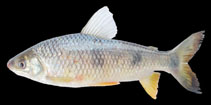
Raggi dorsali molli (totale) : 11 - 12; Raggi anali molli: 10 - 11; Vertebre: 39. Can be diagnosed from most congeners, except Leporinus amblyrhynchus, L. conirostris, L. desmotes, L. despaxi, L. elongatus, L. jatuncochi, L. macrocephalus, L. muyscorum, L. piavussu, L. reinhardti, L. trifasciatus and L. wolfei, by possessing three teeth on each premaxilla and dentary (tooth formula 3/3; vs. tooth formulae 3/4, 4/4 or 4/3). Differs from Leporinus amblyrhynchus, L. conirostris, L. desmotes, L. despaxi, L. jatuncochi, L. macrocephalus, L. muyscorum, L. reinhardti, L. trifasciatus and L. wolfei by having three dark rounded blotches on the body and dark transverse bars usually persistent in large specimens (vs. body with a dark midlateral stripe in L. amblyrhynchus, and L. despaxi; transverse dark bands in L. desmotes and L. jatuncochii; body pale except for a single dark blotch on the caudal peduncle in L. conirostris; first blotch, below the dorsal fin, transversely elongated in L. macrocephalus, L. trifasciatus and L. wolfei; transverse bars faded in large specimens of L. muyscorum; and the blotch on the caudal peduncle longitudinally elongated, not rounded, sometimes making contact with the second blotch in L. reinhardti). Can be further distinguished from Leporinus muyscorum by having six or seven scale rows between lateral line and dorsal-fin origin (vs. five); from Leporinus elongatus by having 16 scales rows around the caudal peduncle (vs. 12). Differs from a similar species Leporinus piavussu by having 41 to 43, rarely 44 perforated scales in the lateral line (vs. 39 to 40, rarely 41). Individuals of Leporinus obtusidens from the upper Rio Paraná basin can be separated from individuals of L. piavussu by having mouth directed somewhat or entirely downward, its cleft at horizontal through ventral orbital margin or slightly below (vs. mouth terminal, its cleft above horizontal through ventral orbital margin) (Ref. 93038)
Body shape (shape guide): elongated.
Adults inhabit medium to large rivers accomplishing very long reproductive and feeding
migration in rivers of the Paraná basin (Ref. 93038). They also occur in ponds. Omnivorous (Ref. 79585). Distinct pairs breed on densely grown weedy places (Ref. 205).
Ciclo vitale e comportamento di accoppiamento
Maturità | Riproduzione | Deposizione | Uova | Fecondità | Larve
Distinct pairs breed on densely grown weedy places (Ref. 205).
Ramirez, J.L., J.L.O. Birindelli and P.M. Galetti Jr., 2017. A new genus of Anostomidae (Ostariophysi: Characiformes): Diversity, phylogeny and biogeography based on cytogenetic, molecular and morphological data. Molecular Phylogenetics and Evolution, 107: 308-323. (Ref. 113781)
Stato della Lista Rossa IUCN (Ref. 130435: Version 2025-2 (Global))
Minaccia per l'uomo
Harmless
Usi umani
Pesca: commerciale; Acquacoltura: commerciale; Pesce da pesca sportiva: si
Strumenti
Rapporti speciali
Scarica XML
Fonti Internet
Stime basate su modelli
Indice di diversità filogenetica (Fonte Biblio.
82804): PD
50 = 0.5010 [Uniqueness, from 0.5 = low to 2.0 = high].
Bayesian length-weight: a=0.01175 (0.00960 - 0.01438), b=3.07 (3.03 - 3.11), in cm total length, based on LWR estimates for this species (Ref.
93245).
Livello trofico (Fonte Biblio.
69278): 3.2 ±0.17 se; based on food items.
Resilienza (Fonte Biblio.
120179): Medio, tempo minimo di raddoppiamento della popolazione 1.4 - 4.4 anni (K=0.19).
Vulnerabilità della pesca (Ref.
59153): Moderate to high vulnerability (50 of 100).
🛈
Nutrienti (Ref.
124155): Calcium = 43.2 [8.4, 104.9] mg/100g; Iron = 0.983 [0.444, 2.393] mg/100g; Protein = 18.6 [16.5, 21.0] %; Omega3 = 0.277 [0.104, 0.741] g/100g; Selenium = 21.6 [7.7, 57.4] μg/100g; VitaminA = 28 [8, 94] μg/100g; Zinc = 1.24 [0.81, 1.89] mg/100g (wet weight);