Umwelt: Milieu / Klimazone / Tiefenbereich / Verbreitungsgebiet
Ökologie
seewasser bathydemersal; tiefenbereich 100 - 1200 m (Ref. 559). Deep-water
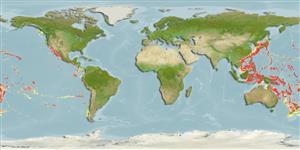
Pacific Ocean: Philippines and Kyushu-Palau Ridge, near the Hawaiian Islands and the Sala y Gomez Ridge.
Größe / Gewicht / Alter
Geschlechtsreife: Lm ? range ? - ? cm
Max length : 15.0 cm SL Männchen/unbestimmt; (Ref. 559)
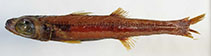
Rückenflossenstacheln (insgesamt) : 7; Rückenflossenweichstrahlen (insgesamt) : 10. Well-developed opercular spines present. Distance between anal opening and the beginning of the anal fin is 27-41 percent of the distance between the base of pelvic fin and the anal opening (Ref. 31632).
Body shape (shape guide): fusiform / normal.
A mesobenthic-pelagic species living mainly above the bottom (Ref. 31632). Inhabits tops of seamounts (Ref. 559). Aggregations hovered over sand patches near steep, irregular cliffs (Ref. 7460).
Lebenszyklus und Paarungsverhalten
Geschlechtsreife | Fortpflanzung | Ablaichen | Eier | Fruchtbarkeit | Larven
Abramov, A.A., 1992. Species composition and distribution of Epigonus (Epigonidae) in the world ocean. J. Ichthyol. 32(5):94-108. (Ref. 31632)
IUCN Rote Liste Status (Ref. 130435: Version 2025-2 (Global))
Bedrohung für Menschen
Harmless
Nutzung durch Menschen
Fischereien: kommerzielles potential
Tools
Zusatzinformationen
Download XML
Internet Quellen
Schätzungen auf der Grundlage von Modellen
Bevorzugte Temperatur (Ref.
123201): 5.8 - 16.8, mean 10.1 °C (based on 252 cells).
Phylogenetischer Diversitätsindex (Ref.
82804): PD
50 = 0.5000 [Uniqueness, from 0.5 = low to 2.0 = high].
Bayesian length-weight: a=0.01202 (0.00571 - 0.02532), b=3.02 (2.84 - 3.20), in cm total length, based on LWR estimates for this Genus-body shape (Ref.
93245).
Trophische Ebene (Ref.
69278): 3.5 ±0.5 se; based on size and trophs of closest relatives
Widerstandsfähigkeit (Ref.
120179): mittel, Verdopplung der Population dauert 1,4 - 4,4 Jahre. (Assuming tm=2-4).
Anfälligkeit der Fischerei (Ref.
59153): Low vulnerability (10 of 100).
🛈