>
Gobiiformes (Gobies) >
Gobiidae (Gobies) > Gobionellinae
Etymology: Gnatholepis: Greek, gnathos = jaw + Greek,lepis = scale (Ref. 45335).
More on author: Bleeker.
Entorno: milieu / zona climática / rango de profundidad / gama de distribución
Ecología
marino; salobre asociado a arrecife; rango de profundidad 1 - 46 m (Ref. 11441). Tropical
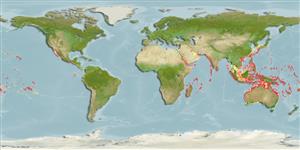
Indo-Pacific: Persian Gulf (Ref.80050) and Red Sea and East Africa to the Hawaiian, Marquesan and Society islands.
Tamaño / Peso / Edad
Madurez: Lm ? range ? - ? cm
Max length : 8.4 cm SL macho / no sexado; (Ref. 41653)
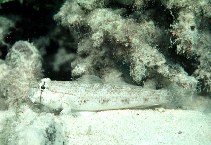
Espinas dorsales (total) : 6 - 7; Radios blandos dorsales (total) : 11; Espinas anales: 1; Radios blandos anales: 11. Distinguished by the following characteristics: ctenoid scales on head, predorsal midline and pectoral fin base, distinct flap present at end of lower lip; at least three dark spots along first spine of first and second dorsal fins, followed by at least three rows of dark spots or short streaks, pectoral fin with rows of fine dark and white speckles; second dorsal and anal fin rays nearly always I,11; pectoral rays 14-17, modally 16; lateral scales 25-29, modally 27; predorsal scales 7-13, usually 9-10, mostly ctenoid, may be cycloid anteriorly or toward midline; body compressed, width at anus 11.9-28.1% (mean 15.2%) of SL; body stocky in appearance, body depth at anus 19.6-26.6% of SL, body depth at first dorsal fin origin 14.3-27.7% of SL; head compressed, broader ventrally, slightly deeper than wide, HL 26.6-33.3% of SL; head depth at posterior preopercular margin 62.0-83.7% of HL; head width at posterior preopercular margin 53.7-82.2% of HL; head profile bluntly pointed; nape slightly convex behind eyes; mouth subterminal to nearly terminal, slightly oblique; jaws generally reaching to below anterior margin of eye; upper jaw length 32.0-41.5% of HL; upper lip smooth, narrower than lower, lower lip papillose close to teeth, with twist or fold posteriorly, forming triangular flap, lip interrupted at chin; eye moderate to relatively small in large specimens, dorsolateral, 22.7-30.5% of HL; preorbital width 18.2-27.8% of HL; snout bluntly pointed, 22.4-44.4% of HL; posterior naris round to almost triangular, close to anterior margin of eye; anterior naris in short tube, higher on posterior margin of eye, about level with middle of eye or somewhat ventral to it; interorbital narrow, 4.7-11.3% of HL; caudal peduncle compressed, length 12.9-18.6% (mean 16.1%) of SL; caudal peduncle depth 10.7-13.8% of SL (Ref. 92171).
Body shape (shape guide): fusiform / normal; Cross section: oval.
Solitary or in loose groups in sand (Ref. 90102). Inhabits shallow coastal bays and estuaries on silty sandy substrates with sparse algae-reef or seagrasses (Ref. 48637). Benthic (Ref. 58302). Feeds on organic matter and small invertebrates (Ref. 89972).
Ciclo vital y comportamiento de apareamiento
Madurez | Reproducción | Puesta | Huevos | Fecundidad | Larva
Benthic spawner.
Randall, J.E. and D.W. Greenfield, 2001. A preliminary review of the Indo-Pacific gobiid fishes of the genus Gnatholepis. Ichthyological Bulletin of the J.L.B. Smith Institute of Ichthyology, 69:1-17. (Ref. 41653)
Situación en la Lista Roja de la UICN (Ref. 130435: Version 2025-2 (Global))
Amenaza para el ser humano
Harmless
Usos humanos
Pesquerías: escaso valor comercial
Herramientas
Informes especiales
Descargar XML
Fuentes de Internet
Estimaciones basadas en modelos
Temperatura preferida (Referencia
123201): 24.3 - 29, mean 27.7 °C (based on 808 cells).
Índice de diversidad filogenética (Referencia
82804): PD
50 = 0.5010 [Uniqueness, from 0.5 = low to 2.0 = high].
Bayesian length-weight: a=0.01023 (0.00452 - 0.02316), b=3.00 (2.81 - 3.19), in cm total length, based on LWR estimates for this (Sub)family-body shape (Ref.
93245).
Nivel trófico (Referencia
69278): 3.4 ±0.5 se; based on size and trophs of closest relatives
Resiliencia (Referencia
120179): Alto, población duplicada en un tiempo mínimo inferior a 15 meses (Preliminary K or Fecundity.).
Vulnerabilidad pesquera (Ref.
59153): Low vulnerability (10 of 100).
🛈
Nutrientes (Ref.
124155): Calcium = 133 [66, 296] mg/100g; Iron = 0.882 [0.415, 1.694] mg/100g; Protein = 18.2 [16.2, 20.0] %; Omega3 = 0.155 [0.068, 0.290] g/100g; Selenium = 23.3 [11.6, 57.7] μg/100g; VitaminA = 117 [29, 421] μg/100g; Zinc = 2.85 [1.88, 4.34] mg/100g (wet weight);