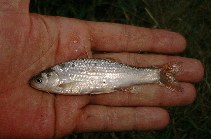
Classification / Noms
Noms communs | Synonymes | Catalog of Fishes(Genre, Espèce) | ITIS | CoL | WoRMS | Cloffa
Environnement : milieu / zone climatique / profondeur / gamme de distribution
Écologie
; eau douce benthopélagique; potamodrome (Ref. 138297).
Deprecated: strtoupper(): Passing null to parameter #1 ($string) of type string is deprecated in /var/www/html/includes/speciessummary.lib.php on line 1612
Temperate; 41°N - 36°N, 9°W - 0°
Europe: Iberian Peninsula from Tagus and lower Ebro drainages southward; missing in Mediterranean slope between Mijares and Vinalopo drainages (present in the upper Jucar) and between Guadaiza and Guadiaro drainages near Malaga. Possibly introduced in Ebro drainages.
Longueur à la première maturité / Taille / Poids / Âge
Maturité: Lm 7.5 range ? - ? cm
Max length : 26.0 cm SL mâle / non sexé; (Ref. 59043); âge max. reporté: 7 années (Ref. 41268)
Description synthétique
Clés d'identification | Morphologie | Morphométrie
Rayons mous dorsaux (Total) : 6 - 9; Rayons mous anaux: 7 - 9; Vertèbres: 37 - 40. Differs from its congeners in Iberian Peninsula by the following characters: 37-42 + 2-3 scales on lateral line; 3-5 scale rows between lateral line and pelvic origin; infraorbital bones broad, width of infraorbitals 2 and 5 about 4-5 times width of sensory canal on same bones; a black crescentic mark on scale pocket of each flank scale (often indistinct in life); head length about equal to body depth; caudal peduncle depth usually 2.0-2.6 times in its length; and mouth terminal, snout pointed (Ref. 59043). Other diagnostic features include communication preopercular-mandibular and infraorbital canals present; and supraethmoid wide and short (Ref. 28035).
Body shape (shape guide): fusiform / normal.
Adults occur in rivers and marshlands (Ref. 26100). An ubiquitous species which inhabits small to medium-sized streams with Mediterranean water regime. May be confined to very small pools during summer. Adults feed mainly on small arthropods. They spawn on stone to gravel bottom in shallow riffle habitats with fast-flowing water. Involved in the Iberocypris alburnoides hybrid complex (Ref. 59043). Threatened due to pollution, habitat destruction and the introduction of other species (Ref. 26100).
Cycle de vie et comportement reproducteur
Maturité | Reproduction | Frai | Œufs | Fécondité | Larves
Kottelat, M. and J. Freyhof, 2007. Handbook of European freshwater fishes. Publications Kottelat, Cornol and Freyhof, Berlin. 646 pp. (Ref. 59043)
Statut dans la liste rouge de l'IUCN (Ref. 130435: Version 2025-2 (Global))
Menace pour l'homme
Harmless
Utilisations par l'homme
Pêche sportive: oui
Outils
Articles particuliers
Télécharger en XML
Sources Internet
Estimations basées sur des modèles
Indice de diversité phylogénétique (Réf.
82804): PD
50 = 0.5000 [Uniqueness, from 0.5 = low to 2.0 = high].
Bayesian length-weight: a=0.00933 (0.00796 - 0.01094), b=3.14 (3.11 - 3.17), in cm total length, based on LWR estimates for this species (Ref.
93245).
Niveau trophique (Réf.
69278): 3.3 ±0.49 se; based on food items.
Résilience (Réf.
120179): Milieu, temps minimum de doublement de population : 1,4 à 4,4 années (K=0.14-0.19; tm=3; tmax=7).
Vulnérabilité de la pêche (Ref.
59153): Low vulnerability (22 of 100).
🛈