>
Kurtiformes (Nurseryfishes, cardinalfishes.) >
Apogonidae (Cardinalfishes) > Apogoninae
Etymology: Taeniamia: Name from feminine Latin noun 'taenia' meaning ribbon or band; and feminine Greek noun 'Amia' meaning a fish, often used with cardinalfishes genera. Here as Taeniamia referring to the vertical wide bars and near vertical to curved narrow bars as lines on most of the species in this genus.
More on author: Smith.
Ambiente: milieu / zona climatica / distribuzione batimetrica / gamma di distribuzione
Ecologia
marino associati a barriera corallina; distribuzione batimetrica 1 - 20 m (Ref. 9710). Tropical
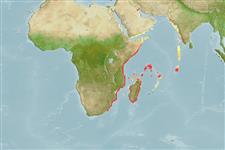
Western Indian Ocean: eastern coast of Africa and its associated islands, from Kenya to KwaZulu-Natal (Ref. 54391). Reported as likely at Seychelles (Ref. 1623) but Randall and van Egmond 1994 (Ref. 10685) believe otherwise.
Dimensione / Peso / Età
Maturità: Lm ? range ? - ? cm
Max length : 8.9 cm SL maschio/sesso non determinato; (Ref. 54391)
Breve descrizione
Chiavi di identificazione | Morfologia | Morfometria
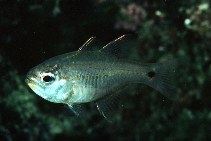
Spine dorsali (totale) : 7; Raggi dorsali molli (totale) : 9; Spine anali: 2; Raggi anali molli: 13 - 15. Diagnosis: Rays: dorsal VI + I,9; anal II,13-15; pectoral rays 14 (rarely 15). Gill rakers 5-6 + 16-18. Lateral-line scales 25+3-4. Median predorsal scales 5-6. Body depth 2.5-2.7 in SL; body width 2.2-2.6 in body depth; eye diameter 2.8-3.2 in head length; first dorsal spine 2.5-3.25 in second spine; second dorsal spine 2.05-2.8, and third dorsal spine 2.1-2.9 in head length; spine of second dorsal fin 2.2-2.5, and second anal spine 2.4-3.1 in head length; pelvic-fin length 4.6-5.1 and caudal-peduncle length 4.1-5.1 in SL; distance from insertion of pelvic spine to anal-fin origin 3.9-5.8 in SL. Posterior preopercular edge serrate on lower half; ventral edge serrate on posterior half. Scaly sheath along anal-fin base well developed (Ref. 54391).
Body shape (shape guide): fusiform / normal.
Occurs in loose aggregations between branching corals or coralline rocks (Ref. 9710), and seaweed in protected waters to a depth of 15 meters (Ref. 54391). Relatively common (Ref. 9710).
Ciclo vitale e comportamento di accoppiamento
Maturità | Riproduzione | Deposizione | Uova | Fecondità | Larve
Are mouthbrooders (Ref. 240). Distinct pairing during courtship and spawning (Ref. 205).
Gon, O. and J.E. Randall, 2003. Revision of the Indo-Pacific cardinalfish genus Archamia (Perciformes: Apogonidae), with description of a new species. Indo-Pac. Fish. (35):49 p. (Ref. 54391)
Stato della Lista Rossa IUCN (Ref. 130435: Version 2025-2 (Global))
Minaccia per l'uomo
Harmless
Usi umani
Strumenti
Rapporti speciali
Scarica XML
Fonti Internet
Stime basate su modelli
Temperatura preferita (Fonte Biblio.
123201): 24.4 - 28.7, mean 27 °C (based on 214 cells).
Indice di diversità filogenetica (Fonte Biblio.
82804): PD
50 = 0.5001 [Uniqueness, from 0.5 = low to 2.0 = high].
Bayesian length-weight: a=0.01122 (0.00521 - 0.02417), b=3.07 (2.89 - 3.25), in cm total length, based on LWR estimates for this (Sub)family-body shape (Ref.
93245).
Livello trofico (Fonte Biblio.
69278): 3.5 ±0.5 se; based on size and trophs of closest relatives
Resilienza (Fonte Biblio.
120179): Alto, tempo minimo di raddoppiamento della popolazione meno di 15 mesi (Preliminary K or Fecundity.).
Vulnerabilità della pesca (Ref.
59153): Low vulnerability (10 of 100).
🛈