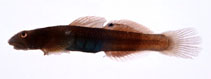
Klassifizierung / Names
Namen | Synonyme | Catalog of Fishes(Gattung, Arten) | ITIS | CoL | WoRMS | Cloffa
>
Gobiiformes (Gobies) >
Gobiidae (Gobies) > Sicydiinae
Etymology: Lentipes: Latin, lens, lentis = slow + Latin, pes = foot (Ref. 45335).
Umwelt: Milieu / Klimazone / Tiefenbereich / Verbreitungsgebiet
Ökologie
; süßwasser benthopelagisch; amphidrom. Subtropical
Asia: Japan, Taiwan and the Philippines.
Größe / Gewicht / Alter
Geschlechtsreife: Lm ? range ? - ? cm
Max length : 5.2 cm SL Männchen/unbestimmt; (Ref. 131024); 5.2 cm SL (female)
Rückenflossenstacheln (insgesamt) : 7; Rückenflossenweichstrahlen (insgesamt) : 10; Afterflossenstacheln: 1; Afterflossenweichstrahlen: 10 - 11. Distinguished from other congeners by the following combinations of features: fin shape and rays counts: second dorsal fin rays I/10; anal fin rays I/10; pectoral fin rays 18-19; first dorsal fin of male with fourth and/or fifth spines longest; small to no interval between first- and second-dorsal-fin bases in male (usually less than 1/3 of the length of the first-dorsal-fin base; the fin bases are often connected); cephalic sensory pore D single; preop�ercular sensory canal usually with two pores, M’ and O’; no enlarged lobes or projections in front of the urogenital papilla of males; lateral scales
reaching anteriorly beyond the area below the origin of the first dorsal fin; scales with large, spike-like ctenii laterally on the trunk in male; and colouration of male without red markings on the body and fins, and with three black vertical lines on the light-blue belly, snout often bearing light blue, second dorsal fin being dark brown proxim�ally and white or light brown distally, with one (some�times two or three) black spot at the anterior part of the second dorsal fin, and anal fin being dark brown proximally and translucent distally (Ref. 125534).
Body shape (shape guide): elongated; Cross section: oval.
Inhabits fast-flowing streams.
Lebenszyklus und Paarungsverhalten
Geschlechtsreife | Fortpflanzung | Ablaichen | Eier | Fruchtbarkeit | Larven
Maeda, K., H. Kobayashi, H.P. Palla, C. Shinzato, R. Koyanagi, J. Montenegro, A.J. Nagano, T. Saeki, T. Kunishima, T. Mukai, K. Tachihara, V. Laudet, N. Satoh and K. Yamahira, 2021. Do colour-morphs of an amphidromous goby represent different species? Taxonomy of Lentipes (Gobiiformes) from Japan and Palawan, Philippines, with phylogenomic approaches. Systematics and Biodiversity 19(8):1080-1112. (Ref. 125534)
IUCN Rote Liste Status (Ref. 130435: Version 2025-2 (Global))
Bedrohung für Menschen
Harmless
Nutzung durch Menschen
Fischereien: nicht kommerziell
Tools
Zusatzinformationen
Download XML
Internet Quellen
Schätzungen auf der Grundlage von Modellen
Phylogenetischer Diversitätsindex (Ref.
82804): PD
50 = 0.5000 [Uniqueness, from 0.5 = low to 2.0 = high].
Bayesian length-weight: a=0.00389 (0.00180 - 0.00842), b=3.12 (2.94 - 3.30), in cm total length, based on all LWR estimates for this body shape (Ref.
93245).
Widerstandsfähigkeit (Ref.
120179): hoch, Verdopplung der Population dauert weniger als 15 Monate. (Preliminary K or Fecundity.).
Anfälligkeit der Fischerei (Ref.
59153): Low vulnerability (10 of 100).
🛈