Meio ambiente: milieu / Zona climática / intervalo de profundidade / faixa de distribuição
Ecologia
; Água doce pelágico(a,os,as); intervalo de profundidade 1 - ? m (Ref. 13851). Tropical; 25°C - 30°C (Ref. 2060); 16°N - 3°N, 17°W - 37°E
Africa: native in all basins of the Sahelo-Sudanese region, the Senegal, Gambia, Corubal, Volta, Ouémé, Niger, Bénoue, Chad and Nile basins and Lake Turkana (Ref. 2920, 3012, 3514). Successful introductions in the storage reservoirs of Côte d'Ivoire, Cross, Sanaga, Nyong and Ogowe rivers and the lower and middle Congo basin, including Ubangui and Kasaï (Ref. 2920); rapidly enlarged its distribution in the Lualaba, upper Congo basin, after extraordinary inundations in 1979 (Ref. 51906). Also introduced in Madagascar (Ref. 3514, 13333). Several countries report adverse ecological impact after introduction.
Comprimento de primeira maturação / Tamanho / Peso / Idade
Maturidade: Lm 40.0, range 40 - 40 cm
Max length : 100.0 cm SL macho/indeterminado; (Ref. 31256); peso máx. publicado: 10.2 kg (Ref. 2920)
Descrição suscinta
Chaves de identificação | Morfologia | Morfometria
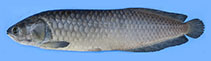
Espinhos dorsais (total) : 0; Raios dorsais (total) : 32 - 37; Espinhos anais: 0; Raios anais : 34 - 39; Vértebras: 66 - 69. Elongated and robust body, its height 3.5-5 times in SL (Ref. 2920). Relatively short head, its length 3.5-5 times in standard length (Ref. 2920, 5156). Dermal bones of cranium deeply carved by large sensory pits (Ref. 1878, 2920). Lips thick; dermal flap on border of gill cover (Ref. 13851). Teeth conical (Ref. 5156). Dorsal and anal fins spineless, elongated and posteriorly positioned, ending close to the small, rounded caudal fin (Ref. 3032, 13851, 28714, 30488). Caudal peduncle very short (Ref. 2756, 3054, 3069). Scales strong, thick, large (Ref. 28714, 30488), oval, with exposed portion thick and corrugated, with a more or less vermiform sculpture (Ref. 53264). 34-40 lateral-line scales, 2.5/6 scales on lateral side of body before pelvic fin, 5-6 scales between dorsal and anal fin (Ref. 367, 2756, 2920, 5156). Lateral line a straight line from above operculum to middle of caudal peduncle (Ref. 1878). Number of gill rakers increases with size: 33 (young) to 98 on ceratobranchial and 21 (young) to 76 on epibranchial (Ref. 2920). Young specimens with external gills (Ref. 30488). Coloration a uniform gray, brown or bronze (Ref. 2920), darker during period of reproduction (Ref. 367). Young specimens often with dark longitudinal bands and scales with an oval spot in posterior zone of anal and dorsal fins (Ref. 2920).
Body shape (shape guide): fusiform / normal; Cross section: compressed.
Obligate air-breathing (Ref. 126274); Obligate air-breathing (Ref. 126274), able to survive in deoxygenated waters; the hardiness of this fish, together with its great growth rate make it a candidate for aquaculture in Africa and it has been transported to a number of countries for this purpose (Ref. 1739, 50623). Escapees from ponds into the wild resulted in established populations, which form the basis for fisheries (Ref. 1739). Maximum observed length in Lake Kainji: 100 cm, observed weight: 10000 g (Ref. 3034, 3799). Young found in swampy places among aquatic vegetation (Ref. 5156, 30488). Adults live in open water of rivers and lakes, in both the pelagic and littoral zone (Ref. 5156). Feeds on mud (Ref. 6160, 28714), phytoplankton (Ref. 3023, 28714, 31256), vegetable debris and small invertebrates (Ref. 28714). The only plankton-feeder of the Osteoglossidae (Ref. 13851). Suprabranchial organ has a sensory function and a mechanic function in concentrating little food particles (Ref. 3012, 50624). During breeding, mature adults create a circular nest in swamps (Ref. 13851, 26281, 41544). Young leave the nest after a few days and are guarded by the male (Ref. 26281).
Breeds in the wet season in swamps and floodplains (Ref. 28714), building a circular nest about 1 m in diameter and 20 to 60 cm deep (Ref. 26281). The rim of the nest is a high wall formed out of plant chunks, about 15-20 cm thick and projecting above the water surface; the bottom is a clean platform of clay or mud; after spawning the fish leave by way of a hole in the wall through which, 5 days later, the young leave the nest and are guarded by the male (Ref. 26281). Also Ref. 3074, 10609, 36900.
Paugy, D., 1990. Osteoglossidae. p. 114-115. In C. Lévêque, D. Paugy and G.G. Teugels (eds.) Faune des poissons d'eaux douces et saumâtres de l'Afrique de l'Ouest. Tome 1. Coll. Faune Trop. n°XXVIII. Musée Royal de l'Afrique Centrale, Tervuren and Éditions de l'ORSTOM, Paris. 384 p. (Ref. 2920)
Status na Lista Vermelha da UICN (Ref. 130435: Version 2025-2 (Global))
Ameaça para os humanos
Potential pest (Ref. 40814)
Uso pelos humanos
Pescarias: espécies comerciais; Aquacultura: espécies comerciais; Aquário: Espécies comerciais
Ferramentas
Relatórios especiais
Baixar XML
Fontes da internet
Estimativas baseadas em modelos
Índice de diversidade filogenética (Ref.
82804): PD
50 = 1.0156 [Uniqueness, from 0.5 = low to 2.0 = high].
Bayesian length-weight: a=0.01175 (0.00854 - 0.01616), b=2.85 (2.76 - 2.94), in cm total length, based on LWR estimates for this species (Ref.
93245).
Nível Trófico (Ref.
69278): 2.7 ±0.1 se; based on diet studies.
Resiliência (Ref.
120179): médio(a), tempo mínimo de duplicação da população 1,4 - 4,4 anos (K=0.22-0.4; Fec > 1,000).
Vulnerabilidade da pesca (Ref.
59153): Moderate to high vulnerability (55 of 100).
🛈
Nutrientes (Ref.
124155): Calcium = 77.4 [37.9, 190.3] mg/100g; Iron = 1.48 [0.76, 3.78] mg/100g; Protein = 16.8 [14.3, 19.1] %; Omega3 = 0.449 [0.166, 1.282] g/100g; Selenium = 76 [24, 210] μg/100g; VitaminA = 20.9 [6.4, 68.6] μg/100g; Zinc = 1.54 [1.01, 2.45] mg/100g (wet weight);