>
Cichliformes (Cichlids, convict blennies) >
Cichlidae (Cichlids) > Pseudocrenilabrinae
Etymology: Hemichromis: Greek, hemis = half + Greek, chromis = a fish, perhaps a perch (Ref. 45335).
More on author: Peters.
Umwelt: Milieu / Klimazone / Tiefenbereich / Verbreitungsgebiet
Ökologie
; süßwasser benthopelagisch; pH range: 7.0 - ? ; dH range: ? - 15; potamodrom (Ref. 51243). Tropical; 23°C - 25°C (Ref. 2060); 27°N - 29°S, 17°W - 47°E
Africa: widely distributed in West Africa, where it is known from most hydrographic basins, from the Senegal to the Chad basins, including the West African coastal rivers and the middle and lower parts of the Chad basin (Ref. 53405, 123791). Also in the Nile basin (Ref. 5644, 28714) and in the upper Zambezi (Ref. 5644). Distribution of this species and overlap with Hemichromis elongatus unclear, but probably absent from the Congo basin (see also Ref. 43352, 52307, 53405, 81260). Introduced around 1970 in a stream fed by hot springs in Villach (Austria) (Ref. 59043).
Länge bei der ersten Reifung / Größe / Gewicht / Alter
Geschlechtsreife: Lm 8.0 range ? - ? cm
Max length : 21.0 cm SL Männchen/unbestimmt; (Ref. 123661); max. veröff. Gewicht: 300.00 g (Ref. 3799)
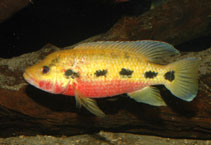
Rückenflossenstacheln (insgesamt) : 13 - 15; Rückenflossenweichstrahlen (insgesamt) : 11 - 14; Afterflossenstacheln: 3; Afterflossenweichstrahlen: 8 - 11. Diagnosis: With 5 dark blotches or cross bars on sides, often alternating with narrower intercalary bars, the first blotch confluent with the opercular spot, the fifth on caudal-fin base; upper profile of snout straight or concave (Ref. 53405). Hemichromis fasciatus can be distinguished from H. elongatus by the small black dots between the first three dark stripes on the flanks of the body of adults in most populations; it can further be distinguished from H. elongatus by a combination of overlapping morphometrics, mainly by: a high number of anal fin soft rays, 8-11 vs. 7-10; number of longitudinal line scales, 29-32 vs. 28-30; number of lower lateral line scales, 10-14 vs. 8-12; a short snout, 27.2-35.2% of head length vs. 27.4-36.4%; short premaxillary pedicel length, 38-49.7% of head length vs. 38.0-51.2%; short head length, 33.1-38.7% of standard length vs. 34.2-40.3%; short predorsal distance, 32.7-39.6% of standard length vs. 34.3-41.3%; short prepectoral distance, 32.9-40.3% of standard length vs. 35.1-42.3%; short prepelvic distance, 35.4-45.3% of standard length vs. 38.2-48.1%; Hemichromis fasciatus is distributed in West Africa while H. elongatus occurs in the southern part of Lower Guinea and the Congo basin in Cameroon (Ref. 123791).
Body shape (shape guide): fusiform / normal.
Found in both forest and savannah biotopes (Ref. 5644); present in littoral riverine habitats and permanent floodplain lagoons with clear water. It feeds on shrimps, small fishes (Ref. 52307) and insects. The species controls large swaths of territory, even larger than those controlled by Hemichromis elongatus; breeding is similar to Hemichromis elongatus (Ref. 52307). A nesting substrate spawner which breeds in the early summer. Pair-bonding well defined (Ref. 52307). Used for tilapia control (Ref. 4537). Maximum TL was recorded at 26.5 cm.
Introduced individuals in Austria reported to form pairs during spawning. Female deposits eggs on exposed hard surfaces such as stones or wood. Both parents guard larvae and juveniles for 4-8 weeks (Ref. 59043).
Teugels, G.G. and D.F.E. Thys van den Audenaerde, 1992. Cichlidae. p. 714-779. In C. Levêque, D. Paugy and G.G. Teugels (eds.) Faune des poissons d'eaux douces et saumâtres d'Afrique de l'Ouest. Tome 2. Coll. Faune Tropicale n° 28. Musée Royal de l'Afrique Centrale, Tervuren, Belgique and O.R.S.T.O.M., Paris, 902 p. (Ref. 7378)
IUCN Rote Liste Status (Ref. 130435: Version 2025-2 (Global))
Bedrohung für Menschen
Harmless
Nutzung durch Menschen
Fischereien: kleinfischerei; Aquakultur: kommerziell; Aquarium: Kommerziell
Tools
Zusatzinformationen
Download XML
Internet Quellen
Schätzungen auf der Grundlage von Modellen
Phylogenetischer Diversitätsindex (Ref.
82804): PD
50 = 0.5625 [Uniqueness, from 0.5 = low to 2.0 = high].
Bayesian length-weight: a=0.01445 (0.01237 - 0.01689), b=2.99 (2.95 - 3.03), in cm total length, based on LWR estimates for this species (Ref.
93245).
Trophische Ebene (Ref.
69278): 3.2 ±0.49 se; based on food items.
Generation time: 1.1 ( na - na) years. Estimated as median ln(3)/K based on 2
growth studies.
Widerstandsfähigkeit (Ref.
120179): hoch, Verdopplung der Population dauert weniger als 15 Monate. (K=1.20; Fec < 1,000).
Anfälligkeit der Fischerei (Ref.
59153): Low vulnerability (14 of 100).
🛈
Nährstoffe (Ref.
124155): Calcium = 186 [102, 364] mg/100g; Iron = 1.86 [1.05, 3.60] mg/100g; Protein = 18.5 [17.0, 19.9] %; Omega3 = 0.515 [0.180, 1.471] g/100g; Selenium = 85.2 [32.7, 225.5] μg/100g; VitaminA = 34.2 [8.7, 101.9] μg/100g; Zinc = 2.33 [1.54, 3.55] mg/100g (wet weight);