>
Cypriniformes (Carps) >
Cyprinidae (Minnows or carps) > Smiliogastrinae
Etymology: Enteromius: Greek, enteron = intestine + Greek, myo, mys = muscle (Ref. 45335).
More on author: Boulenger.
Milieu: milieu / Klimaatzone / Diepte / verspreidingsgebied
Ecologie
; zoet water benthopelagisch. Tropical; 19°C - 25°C (Ref. 1672)
Africa: known from coastal basins in Benin to Cameroon, Chad basin and Benue River system (Ref. 2801, 2940, 81282), Bagoé (Niger basin) (Ref. 2940, 81282). Also present in Ghana (Ref. 272), Côte d'Ivoire (Ref. 272, 2940, 81282), Senegal (Ref. 2940, 81282), Cameroon (Ref. 81282, 81639) and Equatorial Guinea (Ref. 81639). Report from the Chiloango (Ref. 120641) probably refers to E. trispilomimus.
Grootte / Gewicht / Leeftijd
Maturiteit: Lm ? range ? - ? cm
Max length : 10.1 cm TL mannelijk / geslacht onbekend; (Ref. 128374); max. gepubliceerd gewicht: 5.00 g (Ref. 3799)
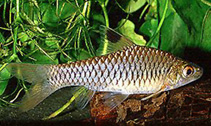
Dorsale stekels (totaal) : 0; Dorsale zachte stralen (totaal) : 11; Anale stekels: 0; Anale zachte stralen: 8. Diagnosis: mouth subterminal; two pairs of short barbels; anterior pair not exceeding anterior margin of eye, posterior pair not reaching to anterior half of eye; lateral line complete and horizontal or slightly depressed below dorsal fin; scale formula 3.5/22-27/3.5; 2.5 scales between lateral line and pelvic-fin base; 12 scales around caudal peduncle; 8 branched dorsal fin rays; last simple dorsal-fin ray smooth on hind margin; no color pattern on sides; black spot on dorsal fin, but tip of fin colorless; maximum reported size 65 mm SL (Ref. 2940, 81282, 81639).
Body shape (shape guide): fusiform / normal.
Affinities: belongs to ablabes group, distinguished from other West African Barbus by the dorsal fin spot. B. deserti (spot fully covering dorsal tip) (Ref. 2940). Maximum SL observed is 65 mm (Ref. 2940, 81282).
Levenscyclus en paargedrag
Maturiteit | Voortplanting | Paaien | Eieren | Fecunditeit | Larven
Lévêque, C. and J. Daget, 1984. Cyprinidae. p. 217-342. In J. Daget, J.-P. Gosse and D.F.E. Thys van den Audenaerde (eds.) Check-list of the freshwater fishes of Africa (CLOFFA). ORSTOM, Paris and MRAC, Tervuren. Vol. 1. (Ref. 2801)
Status op de Rode Lijst van het IUCN (Ref. 130435: Version 2025-2 (Global))
Gevaar voor de mens
Harmless
Gebruik door de mens
Visserij: commercieel; Aquarium: Commercieel
Tools
Speciale rapporten
Download XML
Internetbronnen
Schattingen op basis van modellen
Fylogenetische diversiteitsindex (Ref.
82804): PD
50 = 0.5000 [Uniqueness, from 0.5 = low to 2.0 = high].
Bayesian length-weight: a=0.00977 (0.00623 - 0.01533), b=2.92 (2.79 - 3.05), in cm total length, based on LWR estimates for this species & Genus-body shape (Ref.
93245).
Trofisch niveau (Ref.
69278): 3.0 ±0.3 se; based on size and trophs of closest relatives
Weerstandsvermogen (Ref.
120179): Hoog, minimale populatieverdubbelingstijd minder dan 15 maanden (Preliminary K or Fecundity.).
Kwetsbaarheid van de visserij (Ref.
59153): Low vulnerability (10 of 100).
🛈