>
Cypriniformes (Carps) >
Danionidae (Danios) > Danioninae
Etymology: Devario: Bangla/Bengali:‘debari’, local name for these fishes; also meaning ‘brother in law’ (Ref. 2031).
Entorno: milieu / zona climática / rango de profundidad / gama de distribución
Ecología
; agua dulce bentopelágico. Subtropical
Asia: Irrawaddy basin of Myanmar and China.
Tamaño / Peso / Edad
Madurez: Lm ? range ? - ? cm
Max length : 12.0 cm TL macho / no sexado; (Ref. 4832)
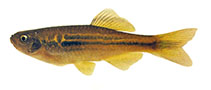
Radios blandos dorsales (total) : 12 - 13; Radios blandos anales: 15 - 16; Vértebra: 33 - 35. With lateral line complete, comprising 31-36; infraorbital process present; branched dorsal fin rays 9-10, branched anal fin rays 11-13. Distinguished from all other Danio species by its color pattern, which includes three dark horizontal stripes separated by three light horizontal interspaces on the side of the body. All three stripes taper posteriad. Stripes and interspaces are narrow, about equal in width. The primary stripe runs along the mid-line of the side and extends to the end of median caudal fin interradial membranes. The P + 1 and P - 1 stripes are separated from the P stripe by a light interspace about half scale wide. Above the P + 1 stripe I + 2 interspace separating it from the dark back of the body. This species can be separated from the most similar species, D. aequipinnatus auct., by having almost equally wide, complete three stripes and three interspaces. By contrast D. aequipinnatus auct. has the P stripe wider and darker than other dark stripes and (1) invaded anteriorly by small light spots derived from the light stripe (I - 1) running immediately ventral to the P stripe or (2) interrupted anteriorly on the side by numerous vertical narrow light bars derived from the light stripes (I + 1 and I - 1) running immediately above and below the P stripe.
Found in small mountain streams. Feeds on terrestrial insects.
Ciclo vital y comportamiento de apareamiento
Madurez | Reproducción | Puesta | Huevos | Fecundidad | Larva
Fang, F., 1997. Redescription of Danio kakhienensis, a poorly known cyprinid fish from the Irrawaddy basin. Ichthyol. Explor. Freshwat. 7(3-4):289-298. (Ref. 13396)
Situación en la Lista Roja de la UICN (Ref. 130435: Version 2025-2 (Global))
Amenaza para el ser humano
Harmless
Usos humanos
Pesquerías: sin interés
Herramientas
Informes especiales
Descargar XML
Fuentes de Internet
Estimaciones basadas en modelos
Índice de diversidad filogenética (Referencia
82804): PD
50 = 0.5000 [Uniqueness, from 0.5 = low to 2.0 = high].
Bayesian length-weight: a=0.00589 (0.00244 - 0.01420), b=3.12 (2.91 - 3.33), in cm total length, based on LWR estimates for this (Sub)family-body shape (Ref.
93245).
Nivel trófico (Referencia
69278): 2.5 ±0.50 se; based on food items.
Resiliencia (Referencia
120179): Medio, población duplicada en un tiempo mínimo de 1.4-4.4 años (Fec=131).
Vulnerabilidad pesquera (Ref.
59153): Low vulnerability (10 of 100).
🛈