>
Cypriniformes (Carps) >
Cyprinidae (Minnows or carps) > Schizothoracinae
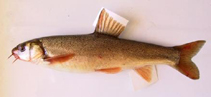
Etymology: Schizopyge: Greek, schizein = to divide + Greek, pyge = tail (Ref. 45335).
More on author: Heckel.
Environnement : milieu / zone climatique / profondeur / gamme de distribution
Écologie
; eau douce benthopélagique; potamodrome (Ref. 51243). Subtropical
Asia: Afghanistan, Pakistan, India (Ref. 41236) and China (Ref. 41093). Reported from Iran (Ref. 39702), Uzbekistan (Ref. 11145), Kazakhstan and Kyrgyzstan (Ref. 1441).
Longueur à la première maturité / Taille / Poids / Âge
Maturité: Lm ?, range 19 - ? cm
Max length : 56.0 cm TL mâle / non sexé; (Ref. 1441); poids max. publié: 1.3 kg (Ref. 4832)
Inhabits river, lakes and swamps. Mature adults undertake spawning migration to incoming streams and breeding takes place amidst gravel and sandy beds (Ref. 40974). Spawning period is extremely protracted, from May until the beginning of August. Large specimens spawn earlier than the small ones. Diet consists of animals and plants (Ref. 1441).
Cycle de vie et comportement reproducteur
Maturité | Reproduction | Frai | Œufs | Fécondité | Larves
Mature adults undertake spawning migration to incoming streams and breeding takes place amidst gravel and sandy beds (Ref. 40974).
Talwar, P.K. and A.G. Jhingran, 1991. Inland fishes of India and adjacent countries. vol 1. A.A. Balkema, Rotterdam. i-liv + 1-541, 1 map (Ref. 4832)
Statut dans la liste rouge de l'IUCN (Ref. 130435: Version 2025-2 (Global))
Menace pour l'homme
Harmless
Utilisations par l'homme
Pêcheries: commercial
Outils
Articles particuliers
Télécharger en XML
Sources Internet
Estimations basées sur des modèles
Indice de diversité phylogénétique (Réf.
82804): PD
50 = 0.7500 [Uniqueness, from 0.5 = low to 2.0 = high].
Bayesian length-weight: a=0.00933 (0.00620 - 0.01404), b=2.95 (2.83 - 3.07), in cm total length, based on LWR estimates for this species & (Sub)family-body (Ref.
93245).
Niveau trophique (Réf.
69278): 2.0 ±0.00 se; based on food items.
Generation time: 0.7 ( na - na) years. Estimated as median ln(3)/K based on 1
growth studies.
Résilience (Réf.
120179): Haut, temps minimum de doublement de population inférieur à 15 mois (Preliminary K or Fecundity.).
Vulnérabilité de la pêche (Ref.
59153): Moderate vulnerability (42 of 100).
🛈
Nutriments (Ref.
124155): Calcium = 342 [179, 708] mg/100g; Iron = 10.2 [3.1, 19.8] mg/100g; Protein = 16.6 [15.4, 18.0] %; Omega3 = 0.292 [0.101, 0.855] g/100g; Selenium = 180 [39, 736] μg/100g; VitaminA = 12.4 [3.0, 50.6] μg/100g; Zinc = 4.81 [2.66, 7.07] mg/100g (wet weight); based on
nutrient studies.