Environnement : milieu / zone climatique / profondeur / gamme de distribution
Écologie
marin; saumâtre démersal; profondeur 2 - 30 m (Ref. 126081). Tropical
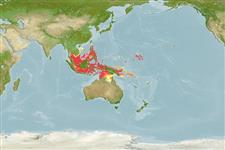
Indo-Pacific: tropical to subtropical waters; southeastern Indian and western Pacific oceans (recorded from Japan, East China Sea, Taiwan, Philippines, Vietnam, Singapore, Indonesia, Papua New Guinea, Samoa, and Australia),
Taille / Poids / Âge
Maturité: Lm ? range ? - ? cm
Max length : 38.0 cm TL mâle / non sexé; (Ref. 4900)
Description synthétique
Clés d'identification | Morphologie | Morphométrie
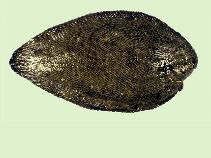
Rayons mous dorsaux (Total) : 64 - 76; Rayons mous anaux: 51 - 62; Vertèbres: 41 - 44. This species is distinguished by the following set of characters: D 64-76 (mode 71); A 51-62; pored lateral line scales on straight portion 93-126 (118); vertebrae 41-44 (43); pectoral-fin rays on ocular side 4-7 (6) and on blind side 4-7 (5); pelvic-fin rays on ocular side 4-6 (5) and blind side 4-5 (4); caudal-fin rays 13-15 (14); body slightly elongate, its depth 40.0-51.0 (mean 45.5)% SL; head length 16.1-23.9 (18.6)% SL; pectoral fin on ocular side longer than that on blind side, 5.3-7.6 (6.6)% SL vs. 4.0-6.0 (4.8)% SL; pelvic fin on ocular side longer than that on blind side, 4.9–7.4 (6.0)% SL vs. 4.3–7.5 (5.8)% SL; body depth below lateral line 21.7-27.1 (23.4)% SL; lips without labial papillae; eyes separated by scaled interorbital space; cycloid or weakly ctenoid scales on blind side. Colouration: body on ocular side uniformly brown or grey with dark vermiculation, some small white blotches along dorsal- and anal-fin bases, or no remarkable pattern (Ref. 126081).
Cross section: compressed.
Inhabits sheltered bays and lagoons on pale sandy substrates near reefs (Ref. 48637). Collected froom from shallow marine and estuarine waters in less than 5 m; but there are underwater photographs of individuals on shallow sandy bottoms between 2–30 m depth (Ref. 126081).
Cycle de vie et comportement reproducteur
Maturité | Reproduction | Frai | Œufs | Fécondité | Larves
Okamoto, J.O. and H. Motomura, 2021. Redescription of Brachirus aspilos (Bleeker 1852), a senior synonym of four nominal species, with a note on the distribution of Dagetichthys marginatus (Boulenger 1900) (Pleuronectiformes: Soleidae). Zootaxa 4908(3):354-368. (Ref. 126081)
Statut dans la liste rouge de l'IUCN (Ref. 130435: Version 2025-2 (Global))
Menace pour l'homme
Harmless
Utilisations par l'homme
Outils
Articles particuliers
Télécharger en XML
Sources Internet
Estimations basées sur des modèles
Température préférée (Réf.
123201): 21.1 - 28.4, mean 27.1 °C (based on 499 cells).
Indice de diversité phylogénétique (Réf.
82804): PD
50 = 0.5000 [Uniqueness, from 0.5 = low to 2.0 = high].
Bayesian length-weight: a=0.00955 (0.00454 - 0.02011), b=3.07 (2.90 - 3.24), in cm total length, based on LWR estimates for this (Sub)family-body shape (Ref.
93245).
Niveau trophique (Réf.
69278): 4.0 ±0.5 se; based on size and trophs of closest relatives
Résilience (Réf.
120179): Milieu, temps minimum de doublement de population : 1,4 à 4,4 années (Preliminary K or Fecundity.).
Vulnérabilité de la pêche (Ref.
59153): Low to moderate vulnerability (28 of 100).
🛈