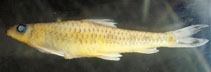
Ambiente: milieu / zona climática / intervalo de profundidade / gama de distribuição
Ecologia
; Água doce demersal. Subtropical
Asia: Ganges River drainage in Bangladesh, India and Nepal; Brahmaputra River drainage in Bangladesh and India; and Meghna and Sungu River drainages in Bangladesh and India.
Tamanho / Peso / Idade
Maturidade: Lm ? range ? - ? cm
Max length : 8.4 cm SL macho/indeterminado; (Ref. 102605)
Descrição breve
Chaves de identificação | Morfologia | Morfometria
Raios dorsais moles (total) : 12 - 13; Raios anais moles: 8; Vértebras: 34. Differs from other species of Psilorhynchus by the presence of large and flap-like skin folds at the lateral corner of the mouth, which reach further posteriorly than the lower jaw cushion and are covered in large 'head of cauliflower' papillae (vs. skin folds not reaching past posteriormost part of lower jaw cushion, non-papilliated or with small dome-like papillae). Can be further diagnosed from other members of P. nudithoracicus species group by the possession of the following characters: two dorsal saddles positioned at dorsal-fin origin; L+2 row present, composed of 5-10 obvious dark brown blotches; mostly 17+17 vertebrae. Can be further separated from P. melissa by its dorsal fin with irregular dark brown or black margins (vs. dorsal fin marked with a dark brown or black band along distal edge); from P. robustus by having dorsal saddles posterior to the dorsal fin poorly developed (vs. dorsal saddles posterior to the dorsal fin well-developed), and by having the anteriormost lateral blotch equal in size or smaller than more posterior blotches (vs. anteriormost lateral blotch larger than more posterior blotches), and from P. tenure by having 9-10+9 principal caudal-fin rays (vs. 9+8); caudal peduncle length 9-13% SL (vs. 14-16% SL); presence (vs. absence) of a short mandibular canal along the anguloarticular; and presence (vs. absence) of a series of indistinct horizontal rows formed by small dark brown spots on the scales above and below the lateral line scale row (Ref. 93866).
Body shape (shape guide): elongated.
Occurs over small pebbles in shallow running waters where the bottom is mainly sand (Ref. 4832). Also found in a slow moving stream with a sandy bed (Ref. 93866).
Ciclo de vida e comportamento de acasalamento
Maturidade | Reprodução | Desova | Ovos | Fecundidade | Larvas
Conway, K.W., D.E. Dittmer, L.E. Jezisek and H.H. Ng, 2013. On Psilorhynchus sucatio and P. nudithoracicus, with the description of a new species of Psilorhynchus from northeastern India (Ostariophysi: Psilorhynchidae). Zootaxa 3686(2):201-243. (Ref. 93866)
Categoria na Lista Vermelha da IUCN (Ref. 130435: Version 2025-2 (Global))
Ameaça para o homem
Harmless
Utilização humana
Pescarias: sem interesse
Ferramentas
Relatórios especiais
Descarregue XML
Fontes da internet
Estimativas baseadas em modelos
Índice de diversidade filogenética (Ref.
82804): PD
50 = 0.5000 [Uniqueness, from 0.5 = low to 2.0 = high].
Bayesian length-weight: a=0.00417 (0.00178 - 0.00974), b=3.16 (2.95 - 3.37), in cm total length, based on LWR estimates for this (Sub)family-body shape (Ref.
93245).
Nível Trófico (Ref.
69278): 2.9 ±0.2 se; based on size and trophs of closest relatives
Vulnerabilidade da pesca (Ref.
59153): Low vulnerability (10 of 100).
🛈