>
Siluriformes (Catfishes) >
Mochokidae (Squeakers or upside-down catfishes) > Chiloglanidinae
Etymology: Chiloglanis: Greek, cheilos = lip + Greek, glanis = a fish that can eat the bait without touching the hook; a cat fish (Ref. 45335).
Eponymy: John Roxborough Norman (1898–1944) was an English ichthyologist who started his working life as a bank clerk. [...] (Ref. 128868), visit book page.
More on author: Pellegrin.
Umwelt: Milieu / Klimazone / Tiefenbereich / Verbreitungsgebiet
Ökologie
; süßwasser benthopelagisch. Tropical; 8°N - 4°N
Africa: endemic to the Cavally River system, Côte d'Ivoire (Ref. 7362, 57223). Reported from the Cess/Nipoué River based on type locality (Ref. 272), but unconfirmed in Ref. 7362, 57223.
Größe / Gewicht / Alter
Geschlechtsreife: Lm ? range ? - ? cm
Max length : 4.6 cm SL Männchen/unbestimmt; (Ref. 57223)
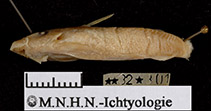
Rückenflossenstacheln (insgesamt) : 1; Rückenflossenweichstrahlen (insgesamt) : 5; Afterflossenstacheln: 0. Diagnosis: labial disk rounded and rather large, its entire surface covered with large papillae; mandibular barbels short, auxiliary barbels absent; premaxillary teeth large, arranged in 3-4 rows; number of mandibular teeth most often 4+4, rarely 5+5; adipose fin beginning slightly ahead of anal-fin origin; eyes moderately developed; in juveniles of both sexes as well as in adult females, caudal fin forked, with rounded lobes, lower lobe longer than upper; in adult males, anal and caudal fins better developed, with median caudal rays longer than upper and lower ones, resulting in a lyre- shaped tail; no longitudinal black band on caudal-fin lobes (Ref. 57223).
Coloration: general appearance dark; body with 3 large, dark vertical bars separated by narrow pale areas; top of head and back more or less uniformly covered with large melanophores that may obscure the pale areas; in some individuals, melanophores also present on pectoral-fin bases and abdomen; anal fin dark; oblique bars on distal part of caudal-fin lobes (Ref. 57223).
Body shape (shape guide): elongated.
Lebenszyklus und Paarungsverhalten
Geschlechtsreife | Fortpflanzung | Ablaichen | Eier | Fruchtbarkeit | Larven
Oviparous (Ref. 205). Distinct pairing during breeding (Ref. 205).
Paugy, D. and T.R. Roberts, 2003. Mochokidae. p. 195-268 In C. Lévêque, D. Paugy and G.G. Teugels (eds.) Faune des poissons d'eaux douce et saumâtres de l'Afrique de l'Ouest, Tome 2. Coll. Faune et Flore tropicales 40. Musée Royal de l'Afrique Centrale, Tervuren, Belgique, Museum National d'Histoire Naturalle, Paris, France and Institut de Recherche pour le Développement, Paris, France. 815 p. (Ref. 57223)
IUCN Rote Liste Status (Ref. 130435: Version 2025-2 (Global))
Bedrohung für Menschen
Harmless
Nutzung durch Menschen
Fischereien: nicht kommerziell
Tools
Zusatzinformationen
Download XML
Internet Quellen
Schätzungen auf der Grundlage von Modellen
Phylogenetischer Diversitätsindex (Ref.
82804): PD
50 = 0.5000 [Uniqueness, from 0.5 = low to 2.0 = high].
Bayesian length-weight: a=0.00389 (0.00180 - 0.00842), b=3.12 (2.94 - 3.30), in cm total length, based on all LWR estimates for this body shape (Ref.
93245).
Trophische Ebene (Ref.
69278): 3.1 ±0.4 se; based on size and trophs of closest relatives
Widerstandsfähigkeit (Ref.
120179): hoch, Verdopplung der Population dauert weniger als 15 Monate. (Preliminary K or Fecundity.).
Anfälligkeit der Fischerei (Ref.
59153): Low vulnerability (10 of 100).
🛈