>
Siluriformes (Catfishes) >
Mochokidae (Squeakers or upside-down catfishes) > Mochokinae
Etymology: Synodontis: Greek, syn, symphysis = grown together + Greek, odous = teeth (Ref. 45335).
More on author: Pellegrin.
Ambiente: milieu / zona climatica / distribuzione batimetrica / gamma di distribuzione
Ecologia
; acqua dolce benthopelagico; pH range: 6.5 - 7.2; dH range: ? - 18. Tropical; 22°C - 25°C (Ref. 2059); 9°N - 5°N
Africa: endemic to the Sassandra basin, Côte d'Ivoire (Ref. 57223.
Dimensione / Peso / Età
Maturità: Lm ? range ? - ? cm
Max length : 14.0 cm SL maschio/sesso non determinato; (Ref. 123661); peso massimo pubblicato: 100.00 g (Ref. 123661)
Spine dorsali (totale) : 1; Spine anali: 0. Diagnosis: gill slits not extending ventrally beyond pectoral-fin insertions; post-orbital length at least 60% of snout length; maxillary barbels longer than head, unbranched, without tubercles, but bordered by a narrow, black, hardly visible, basal membrane; outer mandibular barbels with numerous, rather long, simple and thin ramifications; branches of inner mandibular barbels shorter, subdivided and partly tuberculate; mandibular teeth rather short, numbering 37-47; denticulations of pectoral-fin spines weaker on outer than on inner margins; dorsal-fin spine smooth anteriorly and weakly denticulate posteriorly; humeral process blunt, at most about twice as long as deep, its upper margin more or less convex; adipose fin rather poorly developed and distinctly separated from rayed dorsal fin; body covered with irregular, more or less coalesced spots (Ref. 57223).
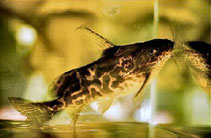
Coloration: rather dark, lighter ventrally; body entirely covered with brownish spots and marblings against a lighter background; spots on ventral body regions also large, but lighter; all fins marked with spots aligned in transverse series; adipose fin of the same colour as rest of body; top of head also spotted (Ref. 57223).
Body shape (shape guide): fusiform / normal.
Maximum TL was recorded at 14.8 cm (Ref. 57223). Oviparous (Ref. 205).
Ciclo vitale e comportamento di accoppiamento
Maturità | Riproduzione | Deposizione | Uova | Fecondità | Larve
Oviparous (Ref. 205). Distinct pairing during breeding (Ref. 205).
Paugy, D. and T.R. Roberts, 2003. Mochokidae. p. 195-268 In C. Lévêque, D. Paugy and G.G. Teugels (eds.) Faune des poissons d'eaux douce et saumâtres de l'Afrique de l'Ouest, Tome 2. Coll. Faune et Flore tropicales 40. Musée Royal de l'Afrique Centrale, Tervuren, Belgique, Museum National d'Histoire Naturalle, Paris, France and Institut de Recherche pour le Développement, Paris, France. 815 p. (Ref. 57223)
Stato della Lista Rossa IUCN (Ref. 130435: Version 2025-2 (Global))
Minaccia per l'uomo
Harmless
Usi umani
Acquario: Commerciale
Strumenti
Rapporti speciali
Scarica XML
Fonti Internet
Stime basate su modelli
Indice di diversità filogenetica (Fonte Biblio.
82804): PD
50 = 0.5000 [Uniqueness, from 0.5 = low to 2.0 = high].
Bayesian length-weight: a=0.00933 (0.00457 - 0.01904), b=2.97 (2.80 - 3.14), in cm total length, based on LWR estimates for this species & Genus-body shape (Ref.
93245).
Livello trofico (Fonte Biblio.
69278): 2.9 ±0.4 se; based on size and trophs of closest relatives
Resilienza (Fonte Biblio.
120179): Alto, tempo minimo di raddoppiamento della popolazione meno di 15 mesi (Preliminary K or Fecundity.).
Vulnerabilità della pesca (Ref.
59153): Low vulnerability (10 of 100).
🛈