>
Alepocephaliformes (Slickheads and tubeshoulders) >
Alepocephalidae (Slickheads)
Etymology: Talismania: Persian, tilism and taken after Greek, telesma, teleo = to make a sacrifice, and after, talisman.
Environnement : milieu / zone climatique / profondeur / gamme de distribution
Écologie
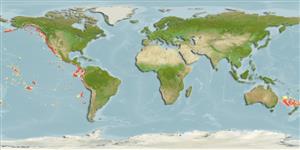
marin bathydémersal; profondeur 300 - 2000 m (Ref. 35724). Deep-water; 62°N - 37°S, 150°E - 75°W
Eastern Pacific: British Columbia, Canada (Ref. 11980) to Peru (Ref. 35724). Southwest Pacific: New South Wales, Australia.
Taille / Poids / Âge
Maturité: Lm ? range ? - ? cm
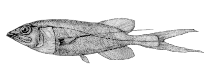
Max length : 27.7 cm SL mâle / non sexé; (Ref. 96339)
Description synthétique
Clés d'identification | Morphologie | Morphométrie
Épines dorsales (Total) : 0; Rayons mous dorsaux (Total) : 17 - 24; Épines anales: 0; Rayons mous anaux: 17 - 24; Vertèbres: 43 - 50. Branchiostegal rays: 7-8.
Occurs on the continental slope (Ref. 7300). Oviparous, with mesopelagic eggs and larvae, or probably in deeper waters (Ref. 35724).
Cycle de vie et comportement reproducteur
Maturité | Reproduction | Frai | Œufs | Fécondité | Larves
Paxton, J.R., D.F. Hoese, G.R. Allen and J.E. Hanley, 1989. Pisces. Petromyzontidae to Carangidae. Zoological Catalogue of Australia, Vol. 7. Australian Government Publishing Service, Canberra, 665 p. (Ref. 7300)
Statut dans la liste rouge de l'IUCN (Ref. 130435: Version 2025-2 (Global))
Menace pour l'homme
Harmless
Utilisations par l'homme
Outils
Articles particuliers
Télécharger en XML
Sources Internet
Estimations basées sur des modèles
Température préférée (Réf.
123201): 3.1 - 8, mean 4.9 °C (based on 110 cells).
Indice de diversité phylogénétique (Réf.
82804): PD
50 = 0.5005 [Uniqueness, from 0.5 = low to 2.0 = high].
Bayesian length-weight: a=0.00339 (0.00159 - 0.00723), b=3.19 (3.00 - 3.38), in cm total length, based on LWR estimates for this (Sub)family-body shape (Ref.
93245).
Niveau trophique (Réf.
69278): 3.5 ±0.5 se; based on size and trophs of closest relatives
Résilience (Réf.
120179): Milieu, temps minimum de doublement de population : 1,4 à 4,4 années (Assuming tmax>3).
Vulnérabilité de la pêche (Ref.
59153): Low vulnerability (24 of 100).
🛈