>
Siluriformes (Catfishes) >
Mochokidae (Squeakers or upside-down catfishes) > Mochokinae
Etymology: Synodontis: Greek, syn, symphysis = grown together + Greek, odous = teeth (Ref. 45335).
Eponymy: Emmanuel-Georges Waterlot (1877–1939) was a French collector of ethnological and natural history specimens (1913–1936) in French West Africa, both for the MNHN, Paris and for the BMNH, London. [...] (Ref. 128868), visit book page.
Milieu: milieu / Klimaatzone / Diepte / verspreidingsgebied
Ecologie
; zoet water benthopelagisch; pH range: 6.8 - 7.8; dH range: ? - 20. Tropical; 22°C - 25°C (Ref. 2059)
Africa: upper Gambia, Corubal, Kogon, Fatala, Konkouré, Great Scarcies/Kolenté, Rokel, Jong/Pampana, Sewa, St. John, Cess and Ofin (Pra tributary) rivers in Senegal, Guinea, Sierra Leone, Liberia, Côte d'Ivoire and Ghana (Ref. 57223).
Grootte / Gewicht / Leeftijd
Maturiteit: Lm ? range ? - ? cm
Max length : 14.1 cm SL mannelijk / geslacht onbekend; (Ref. 57223); max. gepubliceerd gewicht: 85.00 g (Ref. 3799)
Dorsale stekels (totaal) : 1; Anale stekels: 0. Diagnosis: gill slits not extending ventrally beyond pectoral-fin insertions; post-orbital length at least 60% of snout length; maxillary barbels unbranched, longer than head, without tubercles and bordered by a narrow, but rather long, basal membrane that extends over half their length; inner mandibular barbels with few, short, sometimes subdivided, ramifications; mandibular teeth moderately developed, numbering 16-27 (27 in the holotype); denticulations of pectoral-fin spines almost as strong on outer as on inner margin; dorsal-fin spine smooth anteriorly, except for some apical denticles; humeral process relatively pointed and granulose, keeled ventrally; adipose fin low, rather short, its length less than 3 times the distance between rayed dorsal- and adipose fin, pointed posteriorly and well separated from rayed dorsal fin; body entirely spotted (Ref. 57223).
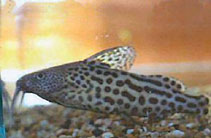
Coloration: ground colour rather light with darker marblings on back and sides, less distinct on lower parts of body; all rayed fins covered with non-aligned spots; adipose fin of the same colour as body; in juveniles, spots larger, fewer and less isolated (Ref. 57223).
Body shape (shape guide): fusiform / normal.
Maximum TL was recorded at 18.5 cm (Ref. 7362, 57223). Oviparous (Ref. 205).
Levenscyclus en paargedrag
Maturiteit | Voortplanting | Paaien | Eieren | Fecunditeit | Larven
Oviparous (Ref. 205). Distinct pairing during breeding (Ref. 205).
Paugy, D. and T.R. Roberts, 2003. Mochokidae. p. 195-268 In C. Lévêque, D. Paugy and G.G. Teugels (eds.) Faune des poissons d'eaux douce et saumâtres de l'Afrique de l'Ouest, Tome 2. Coll. Faune et Flore tropicales 40. Musée Royal de l'Afrique Centrale, Tervuren, Belgique, Museum National d'Histoire Naturalle, Paris, France and Institut de Recherche pour le Développement, Paris, France. 815 p. (Ref. 57223)
Status op de Rode Lijst van het IUCN (Ref. 130435: Version 2025-2 (Global))
Gevaar voor de mens
Harmless
Gebruik door de mens
Visserij: van minder commercieel belang
Tools
Speciale rapporten
Download XML
Internetbronnen
Schattingen op basis van modellen
Fylogenetische diversiteitsindex (Ref.
82804): PD
50 = 0.5000 [Uniqueness, from 0.5 = low to 2.0 = high].
Bayesian length-weight: a=0.01175 (0.00656 - 0.02103), b=3.00 (2.85 - 3.15), in cm total length, based on LWR estimates for this species & Genus-body shape (Ref.
93245).
Trofisch niveau (Ref.
69278): 2.5 ±0.29 se; based on food items.
Weerstandsvermogen (Ref.
120179): Hoog, minimale populatieverdubbelingstijd minder dan 15 maanden (Preliminary K or Fecundity.).
Kwetsbaarheid van de visserij (Ref.
59153): Low vulnerability (10 of 100).
🛈