>
Cypriniformes (Carps) >
Nemacheilidae (Brook loaches)
Etymology: Schistura: Greek, schizein = to divide + Greek, oura = tail; an allusion to forked caudal fins (Ref. 45335); vinciguerrae: Named for Decio Vinciguerra, a former curator in MCSNG who studied Burmese fishes.
Eponymy: Dr Decio Vinciguerra (1856–1934) was an Italian physician, naturalist and ichthyologist at the Museo Civico di Storia Naturale di Genova (1883–1931). [...] (Ref. 128868), visit book page.
More on author: Hora.
Environnement : milieu / zone climatique / profondeur / gamme de distribution
Écologie
; eau douce benthopélagique. Tropical
Asia: Irrawaddy and Salween basins in Myanmar and the Irrawaddy basin in China. Likely to occur in the Salween basin in Yunnan, but needs confirmation (Ref. 39226). Reported from India (Ref. 4832).
Taille / Poids / Âge
Maturité: Lm ? range ? - ? cm
Max length : 8.0 cm NG mâle / non sexé; (Ref. 94495)
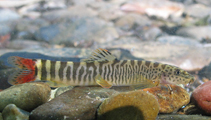
Rayons mous dorsaux (Total) : 12 - 13; Rayons mous anaux: 8. Distinguished from most other nemacheilines by its color pattern: the bars in front of dorsal fin are conspicuously thinner than those behind, usually united in pairs (or more) at their upper extremity. This color pattern is shared with other species. It is distinguished from S. poculi by 9+8 branched caudal rays (versus 8+7), from S. mahnerti and S. bella by the absence of sexual dimorphism (both species have a well developed suborbital flap in males) and by details of the color pattern (Ref. 39226).
Body shape (shape guide): elongated.
Occurs in small streams with pebbly bottom (Ref. 41236). Found in channels with very swift current and bare bottom. The ovaries of a 6.63 cm SL female contain ripe ovulae of about 1.6 mm in diameter (Ref. 39226).
Cycle de vie et comportement reproducteur
Maturité | Reproduction | Frai | Œufs | Fécondité | Larves
Kottelat, M., 1990. Indochinese nemacheilines. A revision of nemacheiline loaches (Pisces: Cypriniformes) of Thailand, Burma, Laos, Cambodia and southern Viet Nam. Verlag Dr. Friedrich Pfeil, München, Germany. 262 p. (Ref. 39226)
Statut dans la liste rouge de l'IUCN (Ref. 130435: Version 2025-2 (Global))
Menace pour l'homme
Harmless
Utilisations par l'homme
Pêcheries: sans intérêt
Outils
Articles particuliers
Télécharger en XML
Sources Internet
Estimations basées sur des modèles
Indice de diversité phylogénétique (Réf.
82804): PD
50 = 0.5000 [Uniqueness, from 0.5 = low to 2.0 = high].
Bayesian length-weight: a=0.00708 (0.00323 - 0.01553), b=3.03 (2.86 - 3.20), in cm total length, based on LWR estimates for this Genus-body shape (Ref.
93245).
Niveau trophique (Réf.
69278): 3.0 ±0.3 se; based on size and trophs of closest relatives
Résilience (Réf.
120179): Milieu, temps minimum de doublement de population : 1,4 à 4,4 années (Preliminary K or Fecundity.).
Vulnérabilité de la pêche (Ref.
59153): Low vulnerability (10 of 100).
🛈