>
Cyprinodontiformes (Rivulines, killifishes and live bearers) >
Nothobranchiidae (African rivulines)
Eponymy: ‘A Maesen’ was one of the collectors of this species, probably referring to Belgian ethnologist Albert Maesen (1915–1992), who explored the Ivory Coast (the type locality) with his professor Frans Olbrechts (q. [...] (Ref. 128868), visit book page.
More on author: Poll.
Taxonomic Remarks
Treated as Aphyosemion maeseni (Ref. 126460), but here placed in Nimbapanchax; this is based on the fan-shaped neural process of the second vertebra of this species, a morphological condition unique to species of Nimbapanchax among nothobranchiids (Ref. 126460).
Environnement : milieu / zone climatique / profondeur / gamme de distribution
Écologie
; eau douce pélagique; dH range: 4 - 12; non migrateur. Tropical; 20°C - 24°C (Ref. 2060)
Africa: northeastern Liberia, southeastern Guinea and western Ivory Coast (Ref. 82704).
Taille / Poids / Âge
Maturité: Lm ? range ? - ? cm
Max length : 4.5 cm SL mâle / non sexé; (Ref. 82704)
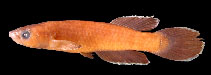
Épines dorsales (Total) : 0; Rayons mous dorsaux (Total) : 10 - 14; Épines anales: 0; Rayons mous anaux: 14 - 18; Vertèbres: 29 - 30. Diagnosis: Nimbapanchax maeseni, N. melanopterygius, N. viridis and N. jeanpoli are distinguished from N. petersi and Aphyosemion guineense by a white or light blue margin around caudal fin, not always completely closed, a small dark brown or reddish submarginal stripe and brown blotches between fin rays, no yellow zone in fins, females without or with small spaced dark bars on side versus an often broad yellow to yellow-greenish or whitish marginal or submarginal zone on anal and lower caudal fin, females on side with wide spaced dark bars in N. petersi and an asymmetrically coloured caudal with white upper and lower margin, a dark brown or red submarginal line and alternating white and brown or red streaks from center to posterior fin margin, sometimes fin center blue-greenish and alternating pattern only in posterior caudal fin in Aphyosemion guineense (Ref. 82704). Nimbapanchax maeseni, N. melanopterygius, N. petersi, N. viridis and Aphyosemion guineense are distinguished from N. jeanpoli by the lack of broad brown or red-brown vertical bars or blotches on side in males; N. maeseni and N. melanopterygius can be distinguished from N. viridis and N. jeanpoli by brown sides of males with center of many scales metallic blue-green, only little red pigmentation on head and sides and a dark brown or red blotch above and slightly posterior to the insertion of pectoral fin on side in females versus blue-green scales with only narrow brown scale margins on the side of males with distinct red dots forming lines or horizontal stripes in N. viridis or the before mentioned brown or red-brown vertical bars or blotches on upper half of side in N. jeanpoli, and no dark blotch above insertion of pectoral fin in females (Ref. 82704). It is distinguished from N. melanopterygius by a white or light blue margin and a dark brown or red submarginal band in the anal fin and a blue-green center in unpaired fins with small dark brown or red dots versus a black, dark brown, or dark red marginal, sometimes white submarginal band in anal fin and a less dense pattern of brown or dark red blotches in anal and caudal fin in N. melanopterygius (Ref. 82704). Nimbapanchax maeseni is distinguished from Aphyosemion guineense, N. melanopterygius, N. jeanpoli and N. viridis by a pattern of vertical stripes on sides formed by metallic blue-greenish scales in young males and a similar pattern of brown stripes in females versus absence of vertical striped pattern or broad, dark brown stripes or blotches on upper half in N. jeanpoli, and vertical stripes only faint in frightened females of N. melanopterygius (Ref. 82704).
Found in brooks, pools and small streams in the forested savanna (Ref. 3788). Not a seasonal killifish; very difficult to maintain in aquarium (Ref. 27139).
Cycle de vie et comportement reproducteur
Maturité | Reproduction | Frai | Œufs | Fécondité | Larves
Romand, R., J.-F. Agnèse and W.J.E.M. Costa, 2020. On the identity of the West African killifish Aphyosemion maeseni Poll, 1941 (Cyprinodontiformes: Aplocheilidae). Cybium 44(3):179-183. (Ref. 126460)
Statut dans la liste rouge de l'IUCN (Ref. 130435: Version 2025-2 (Global))
Menace pour l'homme
Harmless
Utilisations par l'homme
Aquarium: Commercial
Outils
Articles particuliers
Télécharger en XML
Sources Internet
Estimations basées sur des modèles
Indice de diversité phylogénétique (Réf.
82804): PD
50 = 0.5312 [Uniqueness, from 0.5 = low to 2.0 = high].
Bayesian length-weight: a=0.00603 (0.00250 - 0.01453), b=3.13 (2.93 - 3.33), in cm total length, based on LWR estimates for this (Sub)family-body shape (Ref.
93245).
Niveau trophique (Réf.
69278): 3.2 ±0.5 se; based on size and trophs of closest relatives
Vulnérabilité de la pêche (Ref.
59153): Low vulnerability (10 of 100).
🛈