>
Cypriniformes (Carps) >
Danionidae (Danios) > Danioninae
Etymology: Devario: Bangla/Bengali:‘debari’, local name for these fishes; also meaning ‘brother in law’ (Ref. 2031).
Eponymy: Dr Sunder Lal Hora (1896–1955) was a distinguished Indian ichthyologist and biologist who held a doctorate in science from both the Punjab University (1922) and Edinburgh University (1928), having studied for his master’s at the Government College, [...] (Ref. 128868), visit book page.
More on author: Hora.
Environnement : milieu / zone climatique / profondeur / gamme de distribution
Écologie
; eau douce benthopélagique. Tropical
Asia: known only from the Myitnge watershed of the Irrawaddy in northern Shan States, Myanmar (Ref. 36341). Questionable in Thailand (Ref. 1632) and in the Salween basin (Ref. 12041).
Taille / Poids / Âge
Maturité: Lm ? range ? - ? cm
Max length : 7.0 cm TL mâle / non sexé; (Ref. 4832); poids max. publié: 3.90 g (Ref. 124711)
Description synthétique
Clés d'identification | Morphologie | Morphométrie
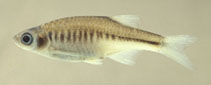
Rayons mous dorsaux (Total) : 10; Rayons mous anaux: 13 - 15; Vertèbres: 33 - 35. Incomplete or complete lateral line; infraorbital process absent; branched dorsal fin rays 7; usually 10 or 11 branched anal fin rays. A distinct series of narrow vertical bars anteriorly on side of body, followed by a horizontal P stripe extending to end of caudal peduncle; barbels absent or rudimentary (Ref. 36341).
Body shape (shape guide): fusiform / normal.
Found in rice fields, small ponds and pools in hill streams (Ref. 4832). Collected from streams with fast flowing, clear water, over a substrate with rocks, sand and pebbles (Ref. 36341). Most specimens obtained in late March 1997 appeared to be sexually mature (Ref. 36341).
Cycle de vie et comportement reproducteur
Maturité | Reproduction | Frai | Œufs | Fécondité | Larves
Fang, F., 2000. Barred Danio species from the Irrawaddy River drainage (Teleostei, Cyprinidae). Ichthyol. Res. 47(1):13-26. (Ref. 36341)
Statut dans la liste rouge de l'IUCN (Ref. 130435: Version 2025-2 (Global))
Menace pour l'homme
Harmless
Utilisations par l'homme
Pêcheries: sans intérêt
Outils
Articles particuliers
Télécharger en XML
Sources Internet
Estimations basées sur des modèles
Indice de diversité phylogénétique (Réf.
82804): PD
50 = 0.5000 [Uniqueness, from 0.5 = low to 2.0 = high].
Bayesian length-weight: a=0.01230 (0.00634 - 0.02388), b=3.05 (2.88 - 3.22), in cm total length, based on LWR estimates for this species & (Sub)family-body (Ref.
93245).
Niveau trophique (Réf.
69278): 3.0 ±0.4 se; based on size and trophs of closest relatives
Résilience (Réf.
120179): Haut, temps minimum de doublement de population inférieur à 15 mois (Preliminary K or Fecundity.).
Vulnérabilité de la pêche (Ref.
59153): Low vulnerability (10 of 100).
🛈