>
Lophiiformes (Anglerfishes) >
Brachionichthyidae (Handfishes)
Etymology: Brachionichthys: Latin, bracchium = arm + Greek, ichthys = fish (Ref. 45335); hirsutus: Name from Latin 'hirsutus' for hairy, in reference to its rough, hairy skin.(Ref. 82446).
More on author: Lacepède.
Περιβάλλον: περιβάλλον / κλιματική ζώνη / εύρος βάθους / εύρος διανομής
Οικολογία
Θαλασσινό(ά) βενθικό(ς); μη μεταναστευτικό(ά); εύρος βάθους 1 - 60 m (Ref. 72490), usually 5 - 15 m (Ref. 72490). Temperate; 41°S - 44°S, 147°E - 149°E
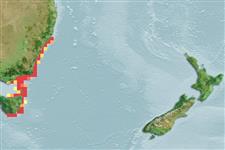
Southwest Pacific: Endemic to Tasmania, Australia. Has been nearly wiped out by an introduced starfish which preys on its egg clusters (Ref. 27438).
Μέγεθος / Βάρος / Ηλικία
Γεννητική Ωρίμανση: Lm ? range ? - ? cm
Max length : 15.0 cm TL αρσενικό/απροσδιόριστο; (Ref. 7300)
Σύντομη περιγραφή
Κλείδες προσδιορισμού | Μορφολογία | Μορφομετρία
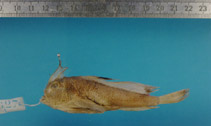
Μαλακές ραχιαίες ακτίνες (συνολικά) : 19 - 21; Μαλακές εδρικές ακτίνες: 8 - 10. This species is unique in having the following set of characters: esca small, 15-26% (mean 20%) of illicium length (including esca); illicium very slender, no dermal spinules, length 19-20% SL (mean 20%), 2.3-2.4 times in head length; eye moderate, exceeding 5.4 times in head; body entirely covered with close-set, non-imbricate scales; scale bases subcircular with long
unicuspid spinules (except for those closely-associated with pores of the acoustico-lateralis system); spinules originating from middle of scale base, variable in length over body; second dorsal-fin rays 17-19 (mean 18), fin base 61-64 (mean 62%) SL; first ray of first dorsal fin length 0.7-1.0 times length of longest ray of second dorsal fin; anal-fin rays 8-10; pectoral-fin rays usually 7 ; upper body usually covered with fine dark spots or short streaks (rarely with long streaks on head); caudal fin with dense coverage of fine spots, forming a dark submarginal bar in juveniles (Ref. 72490).
Body shape (shape guide): elongated.
Occurs in the continental shelf and inshore waters (Ref. 7300). Occurs in coarse to fine sand habitats in depths of 5-40 m (most commonly 5-10 m). Often found in shallow, shell-filled depressions or near rocks of low relief projecting from the substrate (Ref. 30684). Length only preliminary, replace with better value (RF). Egg masses contain about 80-250 eggs, about 1.8-2 mm in diameter; egg capsules about 3-4 mm diameter. Newly hatched juveniles are about 6-7 mm SL, attaining at least 9.0 cm SL (about 13.0 cm TL), with adults commonly about 6.0-7.5 cm SL (Ref. 72490).
Κύκλος ζωής και συμπεριφορά ζευγαρώματος
Γεννητική Ωρίμανση | Αναπαραγωγή | Γεννοβολία | Αβγά | Γονιμότητα | Προνύμφες
Paxton, J.R., D.F. Hoese, G.R. Allen and J.E. Hanley, 1989. Pisces. Petromyzontidae to Carangidae. Zoological Catalogue of Australia, Vol. 7. Australian Government Publishing Service, Canberra, 665 p. (Ref. 7300)
Κατάσταση Κόκκινου Καταλόγου IUCN (Ref. 130435: Version 2025-2 (Global))
Απειλή για τον άνθρωπο
Harmless
Ανθρώπινες χρήσεις
Εργαλεία
Ειδικές εκθέσεις
Λήψη XML
Διαδικτυακές πηγές
Εκτιμήσεις βάσει μοντέλων
Προτιμώμενη θερμοκρασία (Αναφ.
123201): 13.5 - 21.2, mean 15.8 °C (based on 68 cells).
Δείκτης φυλογενετικής ποικιλότητας (Αναφ.
82804): PD
50 = 0.7501 [Uniqueness, from 0.5 = low to 2.0 = high].
Bayesian length-weight: a=0.00437 (0.00164 - 0.01162), b=3.12 (2.89 - 3.35), in cm total length, based on LWR estimates for this (Sub)family-body shape (Ref.
93245).
Τροφικό Επίπεδο (Αναφ.
69278): 3.3 ±0.39 se; based on food items.
Ευπάθεια στην αλιεία (Ref.
59153): Low vulnerability (10 of 100).
🛈