>
Perciformes/Serranoidei (Groupers) >
Anthiadidae (Fairy basslets or Streamer basses)
Etymology: Plectranthias: Bleeker (1873) disagrees with the generic placement of Plectropoma anthioides by Günther. He, therefore, erected Plectranthias to accommodate Pl. anthioides. The name is presumably the combination of the first part of Plectropoma (plectrum), and anthias. Plectrum = Plektron = πλῆκτρον (Greek, plektron = anyhting to strike with, spur + Greek, anthias = a fish, Ref. 45335).
Eponymy: Takeshi Yamakawa (d: 1942) is a fish collecting specialist who is an ichthyologist at Kochi University (Japan). [...] (Ref. 128868), visit book page.
Umwelt: Milieu / Klimazone / Tiefenbereich / Verbreitungsgebiet
Ökologie
seewasser demersal; tiefenbereich ? - 200 m (Ref. 26833). Tropical
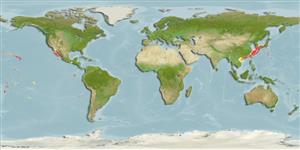
Western Pacific.
Größe / Gewicht / Alter
Geschlechtsreife: Lm ? range ? - ? cm
Max length : 20.0 cm SL Männchen/unbestimmt; (Ref. 559)
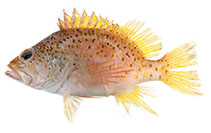
Rückenflossenstacheln (insgesamt) : 10; Rückenflossenweichstrahlen (insgesamt) : 17; Afterflossenstacheln: 3; Afterflossenweichstrahlen: 7; Wirbelzahl: 26. Body reddish yellow above and whitish below, speckled with dark green on upper half of the body when fresh. A large reddish blotch of about eye diameter below lateral line. Ventral, anal and caudal fins yellowish; pectorals reddish. Head thickly scaled except snout, preorbital, lips, both jaws and throat. Cheek with 7 rows of scales. Mouth large, oblique and protractile; lower jaw slightly protruded when closed. Maxillary extends to below the posterior border of pupil.
Body shape (shape guide): short and / or deep; Cross section: compressed.
Found over rocky bottom.
Lebenszyklus und Paarungsverhalten
Geschlechtsreife | Fortpflanzung | Ablaichen | Eier | Fruchtbarkeit | Larven
Randall, J.E., 1980. Revision of the fish genus Plectranthias (Serranidae: Anthiinae) with description of 13 new species. Micronesia 16(1):101-187. (Ref. 8944)
IUCN Rote Liste Status (Ref. 130435: Version 2025-2 (Global))
Bedrohung für Menschen
Harmless
Nutzung durch Menschen
Fischereien: kommerziell
Tools
Zusatzinformationen
Download XML
Internet Quellen
Schätzungen auf der Grundlage von Modellen
Bevorzugte Temperatur (Ref.
123201): 14.7 - 22.4, mean 18.8 °C (based on 107 cells).
Phylogenetischer Diversitätsindex (Ref.
82804): PD
50 = 0.5000 [Uniqueness, from 0.5 = low to 2.0 = high].
Bayesian length-weight: a=0.02512 (0.00978 - 0.06451), b=2.98 (2.75 - 3.21), in cm total length, based on LWR estimates for this (Sub)family-body shape (Ref.
93245).
Trophische Ebene (Ref.
69278): 4.0 ±0.67 se; based on food items.
Widerstandsfähigkeit (Ref.
120179): mittel, Verdopplung der Population dauert 1,4 - 4,4 Jahre. (Preliminary K or Fecundity.).
Anfälligkeit der Fischerei (Ref.
59153): Low vulnerability (14 of 100).
🛈