Environnement : milieu / zone climatique / profondeur / gamme de distribution
Écologie
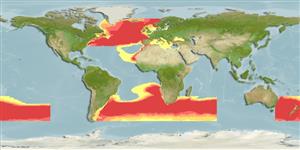
marin bathypélagique; profondeur 40 - 1050 m (Ref. 52180), usually 300 - 700 m (Ref. 52180). Deep-water; 68°N - 55°S, 180°W - 180°E
North Atlantic: Nova Scotia and Grand Banks (Canada) to Massachusetts, USA (Ref. 7251). Also known from the Northeast Atlantic and the Mediterranean Sea. Southeast Atlantic and Indian Ocean: South Africa and Australia (including New South Wales). Southwest Pacific: New Zealand. Southern Ocean. Antitropical.
Taille / Poids / Âge
Maturité: Lm ? range ? - ? cm
Max length : 150 cm SL mâle / non sexé; (Ref. 4542); common length : 60.0 cm TL mâle / non sexé; (Ref. 3397)
Description synthétique
Clés d'identification | Morphologie | Morphométrie
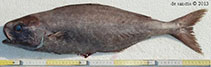
Épines dorsales (Total) : 5; Rayons mous dorsaux (Total) : 37 - 41; Épines anales: 3; Rayons mous anaux: 20 - 24. Dark brown to black, occasionally almost bluish; median and pelvic fins darker than body; young with 2-4 vertical bars (Ref. 4410). Snout is slightly longer than the eye diameter (Ref. 35388).
Body shape (shape guide): fusiform / normal.
An oceanic, epipelagic or mesopelagic species (Ref. 6942). Juveniles occurring in surface waters (Ref. 4542) and associated with pelagic medusas and salps (Ref. 4410), adults found deeper (Ref. 4542). May form small schools. Appears to feed on whatever is available, small fish, squid, large pelagic crustaceans, and other plankton (Ref. 4542).
Cycle de vie et comportement reproducteur
Maturité | Reproduction | Frai | Œufs | Fécondité | Larves
Haedrich, R.L., 1990. Centrolophidae. p. 1011-1013. In J.C. Quero, J.C. Hureau, C. Karrer, A. Post and L. Saldanha (eds.) Check-list of the fishes of the eastern tropical Atlantic (CLOFETA). JNICT, Lisbon; SEI, Paris; and UNESCO, Paris. Vol. 2. (Ref. 6942)
Statut dans la liste rouge de l'IUCN (Ref. 130435: Version 2025-2 (Global))
Menace pour l'homme
Harmless
Utilisations par l'homme
Pêcheries: d'intérêt potentiel; pêche sportive: oui
Outils
Articles particuliers
Télécharger en XML
Sources Internet
Estimations basées sur des modèles
Température préférée (Réf.
123201): 2.7 - 11.9, mean 7 °C (based on 632 cells).
Indice de diversité phylogénétique (Réf.
82804): PD
50 = 1.0000 [Uniqueness, from 0.5 = low to 2.0 = high].
Bayesian length-weight: a=0.00646 (0.00330 - 0.01265), b=3.09 (2.91 - 3.27), in cm total length, based on LWR estimates for this species & (Sub)family-body (Ref.
93245).
Niveau trophique (Réf.
69278): 3.9 ±0.38 se; based on food items.
Résilience (Réf.
120179): Très faible, temps minimum de doublement de population supérieur à 14 ans (Preliminary K or Fecundity.).
Vulnérabilité de la pêche (Ref.
59153): Very high vulnerability (90 of 100).
🛈
Vulnérabilité climatique (Ref.
125649): Moderate vulnerability (38 of 100).
🛈
Nutriments (Ref.
124155): Calcium = 13.3 [4.9, 29.3] mg/100g; Iron = 0.277 [0.123, 0.772] mg/100g; Protein = 18.7 [16.7, 20.6] %; Omega3 = 0.164 [0.069, 0.380] g/100g; Selenium = 21.1 [7.6, 55.5] μg/100g; VitaminA = 20.5 [2.8, 160.8] μg/100g; Zinc = 0.376 [0.209, 0.737] mg/100g (wet weight);