Environnement : milieu / zone climatique / profondeur / gamme de distribution
Écologie
; eau douce; saumâtre démersal; amphidrome (Ref. 46888). Tropical; 22°C - 28°C (Ref. 13614)
Eastern Atlantic: St. Louis (Senegal) to the Cunene River (Angola) and from the islands of the Gulf of Guinea (Ref. 5299, 57403, 79590). Also reported from the lower Kunene in Namibia (Ref. 33857).
Taille / Poids / Âge
Maturité: Lm ? range ? - ? cm
Max length : 14.0 cm SL mâle / non sexé; (Ref. 79590)
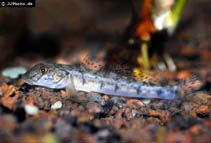
Épines dorsales (Total) : 7; Rayons mous dorsaux (Total) : 10 - 11; Épines anales: 1; Rayons mous anaux: 9 - 11. Diagnosis: snout 33-38% of head length; mouth with 2-3 rows of small, caniniform teeth; head length 24-31% of standard length; 2 fleshy processes on posterior of gill chamber, just inside gill opening; 35 or less cycloid predorsal scales, extending to vertical level of posterior part of preoperculum, predorsal scales may rarely be absent; cheeks and operculum naked; body with strongly ctenoid scales, numbering 54-66 (usually 59 to 63) in longitudinal series (including usually 3-4 scales on caudal fin base); 13-20 scales in rearward transverse series; 16-21 scales around caudal peduncle; 1st dorsal fin: VI; second dorsal fin: I,10 (rarely 11); anal fin: I,9-11 (usually 10), opposed to 2nd dorsal fin; pectoral fins: 14-17; caudal fin: 17 segmented rays (11 to 13 of which are branched); pelvic fins oval; yellowish dorsally, with several (about 14) bands of brown spots over dorsum (Ref. 57403, 79590).
Body shape (shape guide): elongated; Cross section: circular.
Amphidromous freshwater species (Ref. 92840). Often found in lower courses of rivers, ranging from freshwaters to brackish habitats (Ref. 57403, 79590), including brackish waters of intermittent streams during dry seasons (Ref. 5299), but may ascend far up rivers (Ref. 57403, 79590). Also found in flooded fields and marginal swamps along courses of streams and rivers (Ref. 5299). Not usually exceeding 139.8 mm SL, larger specimens may be misidentifications of A. bustamantei (Ref. 79590).
Cycle de vie et comportement reproducteur
Maturité | Reproduction | Frai | Œufs | Fécondité | Larves
Harrison, I.J., P.J. Miller and F. Pezold, 2003. Gobiidae. p. 625-666 In C. Lévêque, D. Paugy and G.G. Teugels (eds.) Faune des poissons d'eaux douce et saumâtres de l'Afrique de l'Ouest, Tome 2. Coll. Faune et Flore tropicales 40. Musée Royal de l'Afrique Centrale, Tervuren, Belgique, Museum National d'Histoire Naturalle, Paris, France and Institut de Recherche pour le Développement, Paris, France. 815 p. (Ref. 57403)
Statut dans la liste rouge de l'IUCN (Ref. 130435: Version 2025-2 (Global))
Menace pour l'homme
Harmless
Utilisations par l'homme
Outils
Articles particuliers
Télécharger en XML
Sources Internet
Estimations basées sur des modèles
Température préférée (Réf.
123201): 25.8 - 28, mean 27.5 °C (based on 170 cells).
Indice de diversité phylogénétique (Réf.
82804): PD
50 = 0.5000 [Uniqueness, from 0.5 = low to 2.0 = high].
Bayesian length-weight: a=0.00724 (0.00377 - 0.01394), b=3.15 (2.99 - 3.31), in cm total length, based on LWR estimates for this species & Genus-body shape (Ref.
93245).
Niveau trophique (Réf.
69278): 2.3 ±0.1 se; based on size and trophs of closest relatives
Résilience (Réf.
120179): Haut, temps minimum de doublement de population inférieur à 15 mois (Preliminary K or Fecundity.).
Vulnérabilité de la pêche (Ref.
59153): Low vulnerability (10 of 100).
🛈