Klassifizierung / Names
Namen | Synonyme | Catalog of Fishes(Gattung, Arten) | ITIS | CoL | WoRMS | Cloffa
>
Gobiiformes (Gobies) >
Gobiidae (Gobies) > Gobionellinae
Etymology: Eugnathogobius: Greek, eu = good + Greek, gnathos = jaw + Latin, gobius = gudgeon (Ref. 45335).
More on author: Herre.
Umwelt: Milieu / Klimazone / Tiefenbereich / Verbreitungsgebiet
Ökologie
; süßwasser; brackwasser demersal. Tropical
Western Pacific: Northeastern Borneo and the Philippines.
Größe / Gewicht / Alter
Geschlechtsreife: Lm ? range ? - ? cm
Max length : 3.6 cm TL Männchen/unbestimmt; (Ref. 7050)
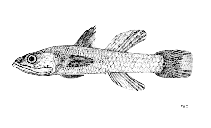
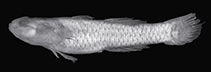
Rückenflossenstacheln (insgesamt) : 6 - 7; Rückenflossenweichstrahlen (insgesamt) : 6 - 8; Afterflossenstacheln: 1; Afterflossenweichstrahlen: 5 - 8. Distinguished by the following characteristics: relatively large size; second dorsal rays I,6-8; pectoral rays 15-18; segmented caudal rays 15-17 (modally 16); longitudinal scales 25-34; TRB 8-12; predorsal scales 10-19; shoulder girdle with smooth low ridge or flange, rarely with fleshy lobes; mouth terminal, large, greatly enlarged in mature males (maxillary sometimes extending past rear edge of preoperculum); each scale on side of body with short dusky bar; two distinct brown stripes extending back from rear of eye and two from eye to snout tip; dark fins, dorsal fins distinctly spotted with brown (Ref. 80545).
Body shape (shape guide): elongated.
A euryhaline species (Ref. 12041). Occurs in estuaries, primarily in slow flowing canals and smaller bodies of water. Feeds on small fishes and invertebrates, including mosquito larvae and entomostracans (Ref. 12693). The following aquarium observations describe its captive behavior and breeding: strictly benthic and quite secretive; males constructed nests under flat stones, shoveling sand with their large mouths while pieces of gravel (up to 12 mm diameter) are carried one by one; males display to each other with mouths wide open and may push against each other jaw to jaw, if observed may often switch to locking jaws (as if biting); about 1,000 eggs per batch (1.5 x 0.5 mm) and hatched after 44-95 hours at 25°C; larvae 2.4 mm long and floated up near the water surface until yolk absorbed after 124 hours, these then moved down into the water column (Ref. 80545). Not seen in the markets (Ref. 12693); rarely collected (Ref. 80545).
Lebenszyklus und Paarungsverhalten
Geschlechtsreife | Fortpflanzung | Ablaichen | Eier | Fruchtbarkeit | Larven
Larson, H.K., 2001. A revision of the gobiid fish genus Mugilogobius (Teleostei: Gobioidei), and its systematic placement. Rec. West. Aust. Mus. (Suppl. No. 62):1-233. (Ref. 43716)
IUCN Rote Liste Status (Ref. 130435: Version 2025-2 (Global))
Bedrohung für Menschen
Harmless
Nutzung durch Menschen
Tools
Zusatzinformationen
Download XML
Internet Quellen
Schätzungen auf der Grundlage von Modellen
Phylogenetischer Diversitätsindex (Ref.
82804): PD
50 = 0.5020 [Uniqueness, from 0.5 = low to 2.0 = high].
Bayesian length-weight: a=0.00708 (0.00332 - 0.01511), b=3.07 (2.89 - 3.25), in cm total length, based on LWR estimates for this (Sub)family-body shape (Ref.
93245).
Trophische Ebene (Ref.
69278): 3.7 ±0.57 se; based on food items.
Widerstandsfähigkeit (Ref.
120179): hoch, Verdopplung der Population dauert weniger als 15 Monate. (Preliminary K or Fecundity.).
Anfälligkeit der Fischerei (Ref.
59153): Low vulnerability (10 of 100).
🛈