>
Gobiiformes (Gobies) >
Oxudercidae (Mudskippers) > Periophthalminae
Etymology: Periophthalmus: Greek, peri = around + Greek, ophthalmos = eye (Ref. 45335).
More on author: Bleeker.
Environnement : milieu / zone climatique / profondeur / gamme de distribution
Écologie
marin; saumâtre démersal. Tropical
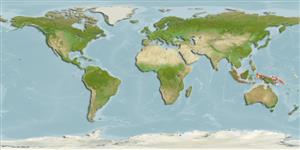
Eastern Indian Ocean: eastern India to Indonesia.
Taille / Poids / Âge
Maturité: Lm ? range ? - ? cm
Max length : 12.9 cm SL mâle / non sexé; (Ref. 7050)
Description synthétique
Clés d'identification | Morphologie | Morphométrie
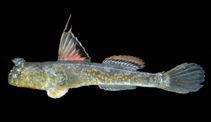
Distinguished by the following: joint ventral fins; ventral fins situated directly behind pectoral fins; pelvis connected with shoulder girdle (Ref. 92840); pelvic fins totally united into a rounded
disk; Dl tall, its margin straight, no stripes or spots on fin, first two spines elongate in males, only first spine elongate in females, first spine in males relatively longer than first spine in females; D2 with dusky stripe mesially; dorsal fins not connected by membrane; Dl with 7-10 spines; longitudinal scale count 64-77; head width 12.6-2l.8% SL; pelvic fin length 12.4-16.8% SL; length of anal fin base 16.7-20.6% SL; length of D2 base 16.3-24.3% SL; total D2 elements 12-13; total anal fin elements 11-13; TRDB 15-19 (Ref. 5218).
Body shape (shape guide): fusiform / normal.
Facultative air-breathing (Ref. 126274); An intertidal and amphibious air-breather (Ref. 31184) found in brackish mangrove and nipa palm areas (Ref. 7050). Actively shuttling back and forth between rock pools and air (Ref. 31184).
Cycle de vie et comportement reproducteur
Maturité | Reproduction | Frai | Œufs | Fécondité | Larves
Kottelat, M., A.J. Whitten, S.N. Kartikasari and S. Wirjoatmodjo, 1993. Freshwater fishes of Western Indonesia and Sulawesi. Periplus Editions, Hong Kong. 221 p. (Ref. 7050)
Statut dans la liste rouge de l'IUCN (Ref. 130435: Version 2025-2 (Global))
Menace pour l'homme
Harmless
Utilisations par l'homme
Pêcheries: sans intérêt
Outils
Articles particuliers
Télécharger en XML
Sources Internet
Estimations basées sur des modèles
Température préférée (Réf.
123201): 28.1 - 29.3, mean 28.9 °C (based on 740 cells).
Indice de diversité phylogénétique (Réf.
82804): PD
50 = 0.5000 [Uniqueness, from 0.5 = low to 2.0 = high].
Bayesian length-weight: a=0.00871 (0.00500 - 0.01517), b=2.86 (2.71 - 3.01), in cm total length, based on LWR estimates for this species & Genus-body shape (Ref.
93245).
Niveau trophique (Réf.
69278): 3.3 ±0.4 se; based on size and trophs of closest relatives
Résilience (Réf.
120179): Haut, temps minimum de doublement de population inférieur à 15 mois (Preliminary K or Fecundity.).
Vulnérabilité de la pêche (Ref.
59153): Low vulnerability (10 of 100).
🛈