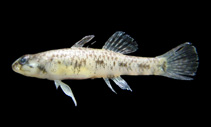
>
Gobiiformes (Gobies) >
Gobiidae (Gobies) > Gobionellinae
Etymology: Pseudogobius: Greek, pseudes = false + Latin, gobius = gudgeon (Ref. 45335).
More on author: Bleeker.
Ambiente: milieu / zona climática / intervalo de profundidade / gama de distribuição
Ecologia
marinhas; Água doce; estuarina demersal; anfídromo (Ref. 51243). Tropical
Indo-West Pacific: western Indonesia, Malaysia, Singapore, Brunei, Thailand, Cambodia, Vietnam, Taiwan, Hong Kong, Philippines and southern Japan; west of Lydekker’s Line.
Tamanho / Peso / Idade
Maturidade: Lm ? range ? - ? cm
Max length : 6.5 cm TL macho/indeterminado; (Ref. 7050)
Facultative air-breathing in the genus (Ref. 126274); Found in shallow-water estuarine, estuaries of rivers, streams and mangroves, at depths of 0–1 m, especially in mangrove habitats (Ref. 126575). Adults also found in the sea (Ref. 4833). Feed on small fishes and invertebrates (Ref. 12693).
Ciclo de vida e comportamento de acasalamento
Maturidade | Reprodução | Desova | Ovos | Fecundidade | Larvas
The male guards the clutch only as long as the young have not hatched.
Larson, H.K. and M.P. Hammer, 2021. A revision of the gobiid fish genus Pseudogobius (Teleostei, Gobiidae, Tridentigerinae), with description of seven new species from Australia and South-east Asia. Zootaxa 4961(1):1-85. (Ref. 126575)
Categoria na Lista Vermelha da IUCN (Ref. 130435: Version 2025-2 (Global))
Ameaça para o homem
Harmless
Utilização humana
Pescarias: sem interesse
Ferramentas
Relatórios especiais
Descarregue XML
Fontes da internet
Estimativas baseadas em modelos
Índice de diversidade filogenética (Ref.
82804): PD
50 = 0.5000 [Uniqueness, from 0.5 = low to 2.0 = high].
Bayesian length-weight: a=0.00708 (0.00332 - 0.01511), b=3.07 (2.89 - 3.25), in cm total length, based on LWR estimates for this (Sub)family-body shape (Ref.
93245).
Nível Trófico (Ref.
69278): 3.3 ±0.5 se; based on size and trophs of closest relatives
Resiliência (Ref.
120179): Elevada, tempo mínimo de duplicação da população menor que 15 meses (Preliminary K or Fecundity.).
Vulnerabilidade da pesca (Ref.
59153): Low vulnerability (10 of 100).
🛈