Taxonomic Remarks
All subspecies of Plecoglossus altivelis (Temminck & Schlegel, 1846) are synonymised under the species in Eschmeyer (CofF ver. Jul. 2010: Ref. 84883). Please send references, or more studies are needed.
Môi trường: môi trường / vùng khí hậu / Mức độ sâu / phạm vi phân phối
Sinh thái học
biển; nước ngọt; thuộc về nước lợ gần đáy; sống cả ở nước ngọt và nuớc mặn (Ref. 138124); mức độ sâu 10 - ? m. Subtropical; 44°N - 23°N
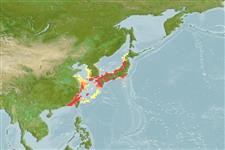
Northwest Pacific: western Hokkaido in Japan southward to the Korean Peninsula, Taiwan and China.
Chiều dài lúc trưởng thành đầu tiên / Bộ gần gũi / Khối lượng (Trọng lượng) / Tuổi
Chín muồi sinh dục: Lm 27.5, range 30 - 40 cm
Max length : 70.0 cm TL con đực/không giới tính; (Ref. 12218); common length : 15.0 cm SL con đực/không giới tính; (Ref. 35840); Tuổi cực đại được báo cáo: 3.00 các năm (Ref. 12218)
Các tia vây lưng cứng (tổng cộng) : 0; Các vây lưng mềm (tổng cộng) : 10 - 11; Tia mềm vây hậu môn: 14 - 15; Động vật có xương sống: 60 - 63. Pyloric caeca 350-400.
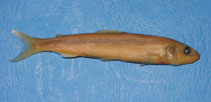
Body shape (shape guide): elongated.
Typical amphidromous fish; appears in near shore from late autumn to spring (Ref. 11230). Found in lakes and rivers, preferring clean river water and can be found the entire river long, from the head to the mouth (Ref. 12218). Ascends the river during March when the temperature is around 10°C (Ref. 12218). Adults spawn in the spring, in the lower reaches of rivers. After spawning, some adults die while others return to the sea. Larvae enter the sea immediately after hatching and remain there during winter, feeding on plankton. In springtime, the young (5-7 cm TL) move upstream to the middle reaches of rivers to feed on algae. Fish (about 6-9 cm) start schooling at the river mouth and are insectivores and eat algae
off small pebbles (Ref. 12218); this is assisted by small leaf-like teeth which are loosely attached to the jaw with two ligaments (Ref. 45181). Those that are ready to spawn (about 20 cm TL) move downstream to the lower reaches of the river. Spawning adults from the sea migrate upstream to the lower reaches as well. Some fish spawn two or three years in succession, others only once (Ref. 9987 & 559). River forms live usually only one year whereas lake forms can live two or three years (Ref. 12218). Reaches maturity at 30-40 cm (Ref. 12218). Highly esteemed food fish. Marketed fresh and consumed fresh, fried and broiled (Ref. 9987).
During spawning some fish go up the river and some fish spawn on the river shoreline above pebbles. Spawns at night and excavates a 10cm (diameter or depth?) pit. Eggs are around 1 mm in size and adhere to the sand or pebbles for 14 to 20 days before hatching. This fish is semelparous and releases eggs many times over a short period each time releasing ~10,000 eggs. Sometimes females that want to spawn but cannot, save their strength, and go to a deep stagnant pool. These females wait until spring before going up the river with young fish. After hatching, the larvae are 6 mm and flow with the water current eating plankton. Juvenile fish will come again to the river in spring. These live in schools. When schools of Plecoglossus altivelis return to their river they guard their territory and eat food (Ref. 12218).
Reproductive mode varies between semelparity and iteroparity. Large females spawn once, while smaller females spawn twice during a two-week interval (Ref. 76896).
Masuda, H., K. Amaoka, C. Araga, T. Uyeno and T. Yoshino, 1984. The fishes of the Japanese Archipelago. Vol. 1. Tokai University Press, Tokyo, Japan. 437 p. (text). (Ref. 559)
Tình trạng Sách đỏ IUCN (Ref. 130435: Version 2025-2 (Global))
Mối đe dọa đối với con người
Harmless
Sử dụng của con người
Các nghề cá: tính thương mại cao; Nuôi trồng thủy sản: tính thương mại; cá để chơi: đúng
Các công cụ
Báo cáo đặc biệt
Tải xuống XML
Các nguồn internet
Ước tính dựa trên mô hình
Nhiệt độ ưa thích (Tài liệu tham khảo
123201): 13 - 22.6, mean 19.7 °C (based on 42 cells).
Chỉ số đa dạng phát sinh loài (Tài liệu tham khảo
82804): PD
50 = 1.5000 [Uniqueness, from 0.5 = low to 2.0 = high].
Bayesian length-weight: a=0.00427 (0.00165 - 0.01101), b=3.07 (2.84 - 3.30), in cm total length, based on LWR estimates for this (Sub)family-body shape (Ref.
93245).
Mức dinh dưỡng (Tài liệu tham khảo
69278): 2.8 ±0.16 se; based on food items.
Thích nghi nhanh (Tài liệu tham khảo
120179): Chiêù cao, thời gian nhân đôi của chủng quần tối thiểu là dưới 15 tháng (tm=1; tmax=3; Fec=50,000-100,000).
Sự dễ bị tổn thương của nghề đánh cá (Ref.
59153): Moderate to high vulnerability (48 of 100).
🛈
Chất dinh dưỡng (Ref.
124155): Calcium = 78 [36, 203] mg/100g; Iron = 1.19 [0.62, 2.98] mg/100g; Protein = 16.2 [13.8, 18.2] %; Omega3 = 0.445 [0.196, 1.234] g/100g; Selenium = 73.2 [35.2, 156.1] μg/100g; VitaminA = 4.44 [1.39, 14.45] μg/100g; Zinc = 0.804 [0.513, 1.253] mg/100g (wet weight);