>
Gobiiformes (Gobies) >
Gobiidae (Gobies) > Gobionellinae
Etymology: Redigobius: Latin,. Redere = to come back + Latin, gobius = gudgeon.
More on author: Bleeker.
Environnement : milieu / zone climatique / profondeur / gamme de distribution
Écologie
marin; eau douce; saumâtre benthopélagique; amphidrome (Ref. 59012); profondeur 0 - 5 m (Ref. 86942). Tropical; 17°N - 20°S
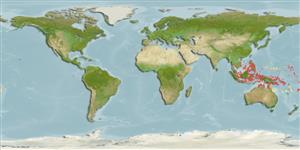
Asia and Oceania: Andaman Islands, Philippines, Indonesia, Micronesia (Palau) and New Guinea. One record from the Solomon Islands may possibly belong to this species. Record from New Caledonia has not been verified yet (Ref. 84480). Reported from Australia, Fiji (Ref. 7050) and Singapore (Ref. 419).
Taille / Poids / Âge
Maturité: Lm ? range ? - ? cm
Max length : 4.5 cm SL mâle / non sexé; (Ref. 7050)
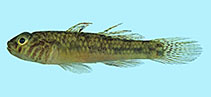
Épines dorsales (Total) : 7; Rayons mous dorsaux (Total) : 6 - 8; Épines anales: 1; Rayons mous anaux: 6 - 7. Distinguished by the following characteristics: slender with compressed head and body; greatly enlarged jaws in adult males with lips distinctively broadened anteriorly and narrowed below eye; body with scale margins outlined forming reticulate pattern; dark band along mid-side of body; head with 4-6 curved oblique dark bands crossing cheek and small dark mark behind upper rear part of eye; variably sized black blotch on posterior part of first dorsal fin; second dorsal rays I,6-8; anal rays I,6-7; pectoral rays 15-18; longitudinal scales 22-25; TRB 7-8 1/2; predorsal scales 6-9 (Ref. 84480).
Body shape (shape guide): fusiform / normal.
Adults inhabit sea and rivers (Ref. 419). Found in estuaries and lower (tidal) reaches of freshwater streams (Ref. 2847). Usually recorded from swift flowing streams, often described as cascades or cascade zone, above or below waterfalls, with solid rock, boulder and gravel substrate. A few sites consisted of mud and sand substrates and one was from a mangrove only 50 m from the shoreline. Gut content of one specimen from Palau contained insect remains and a few nematodes (Ref. 84480).
Cycle de vie et comportement reproducteur
Maturité | Reproduction | Frai | Œufs | Fécondité | Larves
Larson, H.K., 2010. A review of the gobiid fish genus Redigobius (Teleostei: Gobionellina), with descriptions of two new species. Ichthyol. Explor. Freshwat. 21(2):123-191. (Ref. 84480)
Statut dans la liste rouge de l'IUCN (Ref. 130435: Version 2025-2 (Global))
Menace pour l'homme
Harmless
Utilisations par l'homme
Outils
Articles particuliers
Télécharger en XML
Sources Internet
Estimations basées sur des modèles
Température préférée (Réf.
123201): 27.4 - 29.4, mean 28.8 °C (based on 1088 cells).
Indice de diversité phylogénétique (Réf.
82804): PD
50 = 0.5000 [Uniqueness, from 0.5 = low to 2.0 = high].
Bayesian length-weight: a=0.01023 (0.00452 - 0.02316), b=3.00 (2.81 - 3.19), in cm total length, based on LWR estimates for this (Sub)family-body shape (Ref.
93245).
Niveau trophique (Réf.
69278): 3.3 ±0.4 se; based on size and trophs of closest relatives
Résilience (Réf.
120179): Haut, temps minimum de doublement de population inférieur à 15 mois (Preliminary K or Fecundity.).
Vulnérabilité de la pêche (Ref.
59153): Low vulnerability (10 of 100).
🛈