Myxines (hagfishes) >
Myxiniformes (Hagfishes) >
Myxinidae (Hagfishes) > Eptatretinae
Etymology: Eptatretus: hepta (Gr.), seven; tretos (Gr.), perforated (i.e., with holes), referring to seven gill apertures on what would later be described as Homea banksii (=E. cirrhatus) [range within genus is 6-14 pairs of gill apertures] (See ETYFish); deani: In honor of American ichthyologist Bashford Dean (1867-1928), American Museum of Natural History, for his work on the embryology of E. stoutii (See ETYFish).
Eponymy: Dr Bashford Dean (1857–1928) was an American zoologist, ichthyologist and acknowledged expert on mediaeval armour. [...] (Ref. 128868), visit book page.
More on authors: Evermann & Goldsborough.
Environnement : milieu / zone climatique / profondeur / gamme de distribution
Écologie
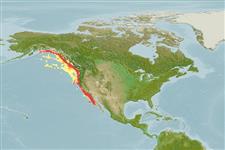
marin bathydémersal; non migrateur; profondeur 103 - 2743 m (Ref. 31276). Deep-water; 60°N - 27°N, 148°W - 114°W
Eastern Pacific: southeastern Alaska to central Baja California, Mexico.
Longueur à la première maturité / Taille / Poids / Âge
Maturité: Lm 38.0 range ? - ? cm
Max length : 63.5 cm TL mâle / non sexé; (Ref. 96339)
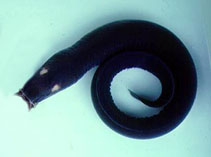
Épines dorsales (Total) : 0; Rayons mous dorsaux (Total) : 0; Épines anales: 0; Rayons mous anaux: 0. No true fins - one dorsal finfold, far back, median, very low, continuous with the caudal; caudal moderately broad, and round with ray-like markings; ventral finfold very low, origin somewhat posterior to last gill aperture, extending to anus (Ref. 6885). Prune colored, preserved specimens black; frequently piebald with light spots; the very edges of caudal and ventral finfolds may be light colored (Ref. 6885).
Body shape (shape guide): eel-like.
Inhabits mud bottoms (Ref. 2850). Minimum depth reported at 103 m (Ref. 80811).
Copulatory organ absent. The gonads of hagfishes are situated in the peritoneal cavity. The ovary is found in the anterior portion of the gonad, and the testis is found in the posterior part. The animal becomes female if the cranial part of the gonad develops or male if the caudal part undergoes differentiation. If none develops, then the animal becomes sterile. If both anterior and posterior parts develop, then the animal becomes a functional hermaphrodite. However, hermaphroditism being characterised as functional needs to be validated by more reproduction studies (Ref. 51361 ). In one study (Ref. 40710), hermaphroditism is exhibited by only 0.2% of the individuals examined.
Fernholm, B., 1998. Hagfish systematics. p. 33-44. In J.M. Jørgensen, J.P. Lomholt, R.E. Weber and H. Malte (eds.) The biology of hagfishes. Chapman & Hall, London. 578 p. (Ref. 31276)
Statut dans la liste rouge de l'IUCN (Ref. 130435: Version 2025-2 (Global))
Menace pour l'homme
Harmless
Utilisations par l'homme
Pêcheries: sans intérêt
Outils
Articles particuliers
Télécharger en XML
Sources Internet
Estimations basées sur des modèles
Température préférée (Réf.
123201): 3.2 - 5.5, mean 4.3 °C (based on 54 cells).
Indice de diversité phylogénétique (Réf.
82804): PD
50 = 0.5000 [Uniqueness, from 0.5 = low to 2.0 = high].
Bayesian length-weight: a=0.00234 (0.00138 - 0.00397), b=2.93 (2.77 - 3.09), in cm total length, based on LWR estimates for this species & (Sub)family-body (Ref.
93245).
Niveau trophique (Réf.
69278): 3.8 ±0.52 se; based on food items.
Résilience (Réf.
120179): Faible, temps minimum de doublement de population : 4,5 à 14 années (Fec = 14).
Vulnérabilité de la pêche (Ref.
59153): Moderate to high vulnerability (45 of 100).
🛈