>
Petromyzontiformes (Lampreys) >
Petromyzontidae (Northern lampreys) > Petromyzontinae
Etymology: Ichthyomyzon: ichthys, fish; myzon (Gr.), to suck (borrowed from Petromyzon), i.e., a sucking fish, referring to their suctorial behavior (See ETYFish); unicuspis: unus (L.), one; cuspis (L.), point, referring to single (unicuspid) cusps of circumoral teeth of adults (compared with bicuspid circumoral teeth of congeners) (See ETYFish).
More on authors: Hubbs & Trautman.
Taxonomic Remarks
Hubbs and Trautman (1937) suggested that one adult specimen from Green Bay, near Gladstone, Lake Michigan Basin, might be a hybrid between I. unicuspis and I. castaneus and another from the Scioto River, Ohio River Basin, might be a hybrid between I. unicuspis and I. bdellium. Starrett et al. (1960) suggested that an adult specimen from the Mississippi River, at Moline, Illinois might be a hybrid between I. castaneus and I. unicuspis (Ref.89241).
Milieu: milieu / Klimaatzone / Diepte / verspreidingsgebied
Ecologie
; zoet water demersaal; potamodroom (Ref. 1998); diepte ? - 31 m (Ref. 89241). Temperate; 59°N - 30°N
North America: St. Lawrence-Great Lakes basin from Quebec to southwest Ontario and south through upper Mississippi and Ohio river basins to Tennessee; Hudson Bay basin in Manitoba; Missouri River in Nebraska and Mississippi River in Mississippi. Readily distinguishable from the sea lamprey by its single dorsal fin.
Lengte bij maturiteit / Grootte / Gewicht / Leeftijd
Maturiteit: Lm 10.0 range ? - ? cm
Max length : 39.2 cm TL mannelijk / geslacht onbekend; (Ref. 89241); common length : 20.1 cm TL mannelijk / geslacht onbekend; (Ref. 12193); max. gerapporteerde leeftijd: 8 Jaren (Ref. 12193)
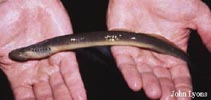
Adults: 8.5-39.2 cm TL and wet weight 34-133 g for individuals 25.0-39.2 cm TL. Body proportions, as percentage of TL (based on 43 specimens measuring 8.5-27.0 cm TL): prebranchial length, 11.4-15.9; branchial length, 8.7-10.8 [8.0-12.2 according to Hubbs and Trautman (1937)]; trunk length, 42.4-49.2; tail length, 25.8-35.0; eye length, 0.7-2.5; disc length, 5.9-12.4. Urogenital papilla length, as a percentage of branchial length, in 7 spawning males measuring 18.5-27.9 cm TL, 5.3-7.7. Trunk myomeres, 47-57. Dentition: supraoral lamina, 1-4 unicuspid teeth, but usually 2; infraoral lamina, 5-12 unicuspid teeth, usually 7-8; 3-6 endolaterals on each side, usually 4; endolateral formula, typically 1-1-1-1; 0-2 bicuspid endolaterals in total, usually 0, the other endolaterals unicuspid; 2-4 rows of anterials; first row of anterials, 1-3 unicuspid teeth; 4-8 rows of exolaterals on each side; 3 rows of posterials; first row of posterials, 8-10 unicuspid teeth; crest of transverse lingual lamina moderately to strongly w-shaped, rarely weakly w-shaped, with about 35 short unicuspid teeth, the median one not enlarged; longitudinal lingual laminae each with 33-40 unicuspid teeth. Well-developed marginal membrane. Velar tentacles, 2-6, smooth. Body coloration (live) a light yellow tan and (preserved) usually yellowish, darker on the dorsal surface, gradually becoming lighter towards the ventral surface with mottling of these shades on the sides; occasionally grayish. Spent individuals blue-back. Lateral line neuromasts darkly pigmented at least by 14.6 cm TL. Extent of caudal fin pigmentation,75% or more. Caudal fin shape, rounded. Oral fimbriae, 81-108. Oral papillae, 15-25 (Ref. 89241).
Body shape (shape guide): eel-like.
Generally associated with warm-water habitats and tolerant of variation in terms of discharge (summer flows 0.06-34 m3/s), water temperature, and substrate. Adults occur principally in the mainstems of large streams. It can also occur in small to large lakes. In Lake Huron, has been collected at depths between 26 and 31 m. Spawning adults are found in streams or lakes (Ref. 89241). Ammocoetes occur in sandy or muddy pools and backwaters. Feeding adults are usually found attached to other fishes in large rivers, lakes, and impoundments. They migrate upriver to spawn in gravel riffles and runs. (Ref. 3221, 10294). Described as anadromous in Ref. 51243. Larval stage lasts for about 4 to 7 years (Ref. 1998, 10294). Metamorphosis occurs in November, in Michigan. Duration of adult stage 12-13 months in Québec (Ref. 89241). Adults are parasitic for 1 to 2 years. Semelparous (Ref. 1998). In Ohio, the spawning period is from 26 April to 2 June. In Michigan, the spawning period is from 23 May to 26 June, at water temperatures between 12.8-22.8 ˚C, with peak spawning activity in early June. Nests are built in streams having 3.5-30 m width, 10-61 cm depth, and 0.1-4.2 m3/s flow. A nest can be 30-cm in diameter, open on the downstream side, 8-15 cm deep, and it can also contain sticks and twigs. Up to ten spawning lampreys have been found in a nest. Fecundity, 10,800 eggs/female. Spawning occurs during daylight hours and into dusk. There are reported occurrences in Michigan of communal spawning of Silver Lamprey with Northern Brook Lamprey (Pine River), of Silver Lamprey with Sea Lamprey (Carp Lake, Devils, East Au Gres, and Rifle rivers), and of Silver Lamprey, with Sea Lamprey, and American Brook Lamprey (Carp Lake River). In the Laurentian Great Lakes Basin, it has been negatively affected by control measures directed towards Petromyzon marinus, except for the chemosterilization of males, which affects only the latter species (Ref. 89241).
McClanes, A.J. (ed.), 1974. Field guide to freshwater fishes of North America. Holt, Rinehart and Winston, New York. 212 p. (Ref. 3221)
Status op de Rode Lijst van het IUCN (Ref. 130435: Version 2025-2 (Global))
Gevaar voor de mens
Harmless
Gebruik door de mens
Aas: occasionally
Tools
Speciale rapporten
Download XML
Internetbronnen
Schattingen op basis van modellen
Fylogenetische diversiteitsindex (Ref.
82804): PD
50 = 0.5156 [Uniqueness, from 0.5 = low to 2.0 = high].
Bayesian length-weight: a=0.00105 (0.00040 - 0.00275), b=3.03 (2.80 - 3.26), in cm total length, based on LWR estimates for this (Sub)family-body shape (Ref.
93245).
Trofisch niveau (Ref.
69278): 4.5 ±0.80 se; based on food items.
Weerstandsvermogen (Ref.
120179): laag, minimale populatieverdubbelingstijd 4,5-14 jaar (tmax=8; tm=6; Fec=10,800).
Kwetsbaarheid van de visserij (Ref.
59153): Low to moderate vulnerability (29 of 100).
🛈