Elasmobranchii (Haie und Rochen) (sharks and rays) >
Carcharhiniformes (Ground sharks) >
Triakidae (Houndsharks) > Triakinae
Etymology: Mustelus: Latin for weasel, an ancient name for sharks, possibly referring to the pointed snouts, swift movements and/or rapacious feeding behavior of smaller predatory sharks [strictly not tautonymous with Squalus mustelus Linnaeus 1758 since type was designated by the ICZN] (See ETYFish); californicus: -icus (L.), belonging to: California, referring to its common occurrence along the coast of California (USA) (See ETYFish).
More on author: Gill.
Umwelt: Milieu / Klimazone / Tiefenbereich / Verbreitungsgebiet
Ökologie
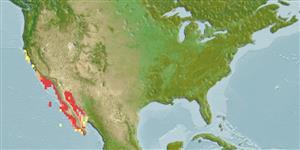
seewasser demersal; tiefenbereich 0 - 200 m (Ref. 55308), usually 2 - 46 m (Ref. 55308). Subtropical; 40°N - 23°N, 126°W - 109°W (Ref. 55308)
Eastern Pacific: northern California, USA to the Gulf of California. At the southern part of its range, this species is sympatric with Mustelus lunulatus, but the two are readily distinguishable.
Länge bei der ersten Reifung / Größe / Gewicht / Alter
Geschlechtsreife: Lm 78.1, range 85 - ? cm
Max length : 116 cm TL Männchen/unbestimmt; (Ref. 244); 124.0 cm TL (female); max. veröff. Alter: 9 Jahre (Ref. 6098)
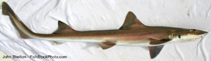
A common inshore and offshore shark found on the continental shelves, and entering shallow muddy bays. Feeds mostly on crabs, including cancrids and grapsids, ghost shrimp, innkeeper (echiuroid) worms (Urechis), and small fish (herring and midshipmen, Porichthys). Viviparous (with a yolk-sac placenta), with 2 to 5 young in a litter. Utilized for human consumption.
Viviparous with a yolk-sac placenta (Ref. 244).
Compagno, L.J.V., 1984. FAO Species Catalogue. Vol. 4. Sharks of the world. An annotated and illustrated catalogue of shark species known to date. Part 2 - Carcharhiniformes. FAO Fish. Synop. 125(4/2):251-655. Rome: FAO. (Ref. 244)
IUCN Rote Liste Status (Ref. 130435: Version 2025-2 (Global))
Bedrohung für Menschen
Harmless
Nutzung durch Menschen
Fischereien: kommerziell; Sportfisch: ja
Tools
Zusatzinformationen
Download XML
Internet Quellen
Schätzungen auf der Grundlage von Modellen
Bevorzugte Temperatur (Ref.
123201): 15.1 - 23.3, mean 20.9 °C (based on 46 cells).
Phylogenetischer Diversitätsindex (Ref.
82804): PD
50 = 0.5000 [Uniqueness, from 0.5 = low to 2.0 = high].
Bayesian length-weight: a=0.00229 (0.00107 - 0.00491), b=3.14 (2.97 - 3.31), in cm total length, based on LWR estimates for this Genus-body shape (Ref.
93245).
Trophische Ebene (Ref.
69278): 3.5 ±0.2 se; based on diet studies.
Generation time: 4.4 ( na - na) years. Estimated as median ln(3)/K based on 2
growth studies.
Widerstandsfähigkeit (Ref.
120179): sehr niedrig, Verdopplung der Population dauert mehr als 14 Jahre. (K=0.22-0.35; tm=1.3-2.1; tmax=12; Fec=2).
Anfälligkeit der Fischerei (Ref.
59153): Moderate to high vulnerability (52 of 100).
🛈
Nährstoffe (Ref.
124155): Calcium = 20.7 [5.6, 105.3] mg/100g; Iron = 0.522 [0.162, 2.021] mg/100g; Protein = 21.8 [19.4, 24.1] %; Omega3 = 0.139 [0.057, 0.331] g/100g; Selenium = 42.6 [12.0, 151.0] μg/100g; VitaminA = 5.54 [1.87, 15.85] μg/100g; Zinc = 0.595 [0.263, 1.199] mg/100g (wet weight);