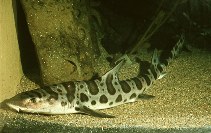
Elasmobranchii (tubarões e raias) (sharks and rays) >
Carcharhiniformes (Ground sharks) >
Triakidae (Houndsharks) > Triakinae
Etymology: Triakis: tri-, from tres (L.), three; akis (Gr.), point, referring to each tooth consisting of one large central cusp flanked on by both sides by a small cusplet (See ETYFish); semifasciata: semi-, from semis (L.), half; fasciatus (L.), banded, referring to striking black saddle marks that cover only dorsal half of body (See ETYFish).
More on author: Girard.
Meio ambiente: milieu / Zona climática / intervalo de profundidade / faixa de distribuição
Ecologia
marinhas; estuarina demersal; intervalo de profundidade 0 - 156 m (Ref. 96339), usually ? - 6 m (Ref. 55312). Subtropical; 45°N - 19°N, 126°W - 105°W (Ref. 55312)
Eastern Pacific: Oregon, USA to the Gulf of California.
Comprimento de primeira maturação / Tamanho / Peso / Idade
Maturidade: Lm 109.8, range 100 - 129 cm
Max length : 198 cm TL macho/indeterminado; (Ref. 244); 180.0 cm TL (female); common length : 160 cm TL macho/indeterminado; (Ref. ); peso máx. publicado: 18.4 kg (Ref. 40637); idade máx. registrada: 30 anos (Ref. 6145)
Found in shallow water from the intertidal to deeper waters, most commonly in enclosed muddy bays; including estuaries and lagoons (S. Wilson, pers. comm.). Prefer sandy areas, mud flats, and bottoms strewn with rocks near rocky reefs and kelp beds. Feed mainly on crabs, shrimps, bony fish, fish eggs, clam necks and innkeeper worms among a large variety of food in its diet. Form mixed schools. Ovoviviparous (aplacental), with 4 to 29 young in a litter. Utilized fresh or frozen for human consumption.
Females produce 6-24 young, which are 20-23 cm long at birth (Ref. 43439). Ovoviviparous, embryos feed solely on yolk (Ref. 50449).
Compagno, L.J.V., 1984. FAO Species Catalogue. Vol. 4. Sharks of the world. An annotated and illustrated catalogue of shark species known to date. Part 2 - Carcharhiniformes. FAO Fish. Synop. 125(4/2):251-655. Rome: FAO. (Ref. 244)
Status na Lista Vermelha da UICN (Ref. 130435: Version 2025-2 (Global))
Ameaça para os humanos
Harmless
Uso pelos humanos
Pescarias: espécies comerciais; peixe esportivo: sim; Aquário: Espécies comerciais
Ferramentas
Relatórios especiais
Baixar XML
Fontes da internet
Estimativas baseadas em modelos
Temperatura preferida (Ref.
123201): 12.8 - 24, mean 20.4 °C (based on 131 cells).
Índice de diversidade filogenética (Ref.
82804): PD
50 = 0.5312 [Uniqueness, from 0.5 = low to 2.0 = high].
Bayesian length-weight: a=0.00234 (0.00124 - 0.00443), b=3.12 (2.96 - 3.28), in cm total length, based on LWR estimates for this species & (Sub)family-body (Ref.
93245).
Nível Trófico (Ref.
69278): 3.7 ±0.2 se; based on diet studies.
Resiliência (Ref.
120179): Muito baixo(a), tempo mínimo de duplicação da população maior que 14 anos (K=0.07-0.09; tm=11-21; tmax=30; Fec=4-12).
Vulnerabilidade da pesca (Ref.
59153): Very high vulnerability (80 of 100).
🛈