Lớp phụ Cá sụn (cá mập và cá đuối) (sharks and rays) >
Squaliformes (Sleeper and dogfish sharks) >
Somniosidae (Sleeper sharks)
Etymology: Somniosus: Latin for sleepy, reflecting Lesueur’s surmise that these sharks are slow or sluggish because of their relatively small fins (hence the name sleeper sharks) (See ETYFish); pacificus: -icus (L.), belonging to: the Pacific Ocean (specifically, the North Pacific), where it occurs (also in Arctic Ocean) (See ETYFish).
Môi trường: môi trường / vùng khí hậu / Mức độ sâu / phạm vi phân phối
Sinh thái học
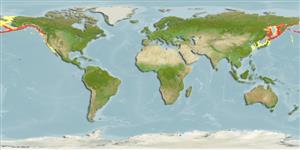
biển sống nổi và đáy; Ở đại duơng, biển (Ref. 138310); mức độ sâu 0 - 2205 m (Ref. 119696). Boreal; 72°N - 23°N, 121°E - 110°W
North Pacific and Arctic: Taiwan to Japan and Kuril Islands, Sea of Okhotsk, southeastern Kamchatka, Commander and Aleutian Islands, and southern Baja California to Gulf of Alaska, Bering Sea, Chukchi Sea and Beaufort Sea.
Bộ gần gũi / Khối lượng (Trọng lượng) / Tuổi
Chín muồi sinh dục: Lm ? range ? - ? cm
Max length : 440 cm TL con đực/không giới tính; (Ref. 247); 430.0 cm TL (female)
Các tia vây lưng cứng (tổng cộng) : 0; Tia cứng vây hậu môn: 0. Diagnosis: Somniosus pacificus differs from S. antarcticus by the following characters: interdorsal space about 70% of prebranchial length (vs. 80%); height of first dorsal fin about 3.7% of precaudal length (PCL) (vs. 3.0%); height of second dorsal fin about 3.4% of PCL (vs. 2.9%); number of turns in spiral valve 32-37 (mode 33) (vs. 36-41, mode 39); precaudal vertebrae 28-30 (mode 29) (vs. 30-31, mode 30) (Ref. 50224).
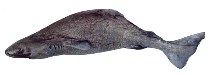
Body shape (shape guide): elongated.
Demersal and mesobenthopelagic (Ref. 119696); found on continental shelves and slopes (Ref. 247). At high latitudes, they occasionally occur in littoral and even intertidal areas; in lower latitudes ithey may never come to the surface and down to at least 2,000 m (Ref. 247), reported to about 2,205 m in the Hawaiian Is. as recorded by camera arrays (Ref. 119696). They feed on bottom animals such as fishes, octopi, squids, crabs and tritons; also harbor seals and carrion (Ref. 247). Ovoviviparous (Ref. 205), with 300 pups in a litter (Ref. 247), length at birth about 42 cm or less (Ref. 26346). The flesh contains a type of toxin which, when eaten, produces symptoms of drunkenness (Ref. 583). Possibly reaches lengths greater than 700 cm (Ref. 247). It is of limited importance in fisheries, with older small-scale commercial harvests reported in southern areas; and based on its population dynamics it can be sensitive to overfishing (Ref. 117245).
Vòng đời và hành vi giao phối
Chín muồi sinh dục | Sự tái sinh sản | Đẻ trứng | Các trứng | Sự sinh sản | Ấu trùng
Probably ovoviviparous (Ref. 247). Size at birth 42 cm or less (Ref. 26346). Distinct pairing with embrace (Ref. 205).
Yano, K., J.D. Stevens and L.J.V. Compagno, 2004. A review of the systematics of the sleeper shark genus Somniosus with redescriptions of Somniosus (Somniosus) antarcticus and Somniosus (Rhinoscymnus) longus (Squaliformes: Somniosidae). Ichthyol. Res. 51:360-373. (Ref. 50224)
Tình trạng Sách đỏ IUCN (Ref. 130435: Version 2025-2 (Global))
Mối đe dọa đối với con người
Sử dụng của con người
Các nghề cá: không ích lợi (thú vị)
Các công cụ
Báo cáo đặc biệt
Tải xuống XML
Các nguồn internet
Ước tính dựa trên mô hình
Nhiệt độ ưa thích (Tài liệu tham khảo
123201): 0.5 - 4.5, mean 2.3 °C (based on 400 cells).
Chỉ số đa dạng phát sinh loài (Tài liệu tham khảo
82804): PD
50 = 0.5156 [Uniqueness, from 0.5 = low to 2.0 = high].
Bayesian length-weight: a=0.00575 (0.00319 - 0.01039), b=3.09 (2.93 - 3.25), in cm total length, based on LWR estimates for this species & (Sub)family-body (Ref.
93245).
Mức dinh dưỡng (Tài liệu tham khảo
69278): 4.4 ±0.4 se; based on diet studies.
Thích nghi nhanh (Tài liệu tham khảo
120179): thấp, thời gian nhân đôi của chủng quần tối thiểu là 4.5 - 14 năm (Fec=300; assuming tm<=10).
Sự dễ bị tổn thương của nghề đánh cá (Ref.
59153): Very high vulnerability (90 of 100).
🛈
Sự dễ bị tổn thương của khí hậu (Ref.
125649): Moderate vulnerability (38 of 100).
🛈