>
Centrarchiformes (Basses) >
Cheilodactylidae (Morwongs)
Etymology: Cheilodactylus: Greek, cheilos = lip + Greek, daktylos = finger (Ref. 45335); referring to the fleshy lips and the lower, unbranched pectoral-fin rays (Ref. 120445).
Eponymy: Pixie John was a South African of whom we know little beyond what Smith’s etymology says: “The specific name pixi is a contraction of the name Pixie in honour of Mr Pixie John, formerly of Port Alfred, who sent me the first specimen and always [...] (Ref. 128868), visit book page.
Entorno: milieu / zona climática / rango de profundidad / gama de distribución
Ecología
marino demersal; rango de profundidad ? - 97 m (Ref. 5319), usually 5 - 30 m (Ref. 5319). Subtropical
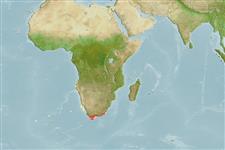
Southeast Atlantic: Namibia to South Africa.
Tamaño / Peso / Edad
Madurez: Lm ? range ? - ? cm
Max length : 18.0 cm TL macho / no sexado; (Ref. 5319)
Descripción breve
Claves de identificación | Morfología | Morfometría
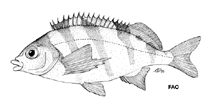
Espinas dorsales (total) : 18 - 20; Radios blandos dorsales (total) : 19 - 23; Espinas anales: 3; Radios blandos anales: 9 - 11. Body bars from top to bottom.
Body shape (shape guide): fusiform / normal.
Found among rocks.
Ciclo vital y comportamiento de apareamiento
Madurez | Reproducción | Puesta | Huevos | Fecundidad | Larva
Smith, M.M., 1986. Cheilodactylidae. p. 667-668. In M.M. Smith and P.C. Heemstra (eds.) Smiths' sea fishes. Springer-Verlag, Berlin. (Ref. 5319)
Situación en la Lista Roja de la UICN (Ref. 130435: Version 2025-2 (Global))
Amenaza para el ser humano
Harmless
Usos humanos
Herramientas
Informes especiales
Descargar XML
Fuentes de Internet
Estimaciones basadas en modelos
Temperatura preferida (Referencia
123201): 16.1 - 22.2, mean 19.5 °C (based on 10 cells).
Índice de diversidad filogenética (Referencia
82804): PD
50 = 1.0000 [Uniqueness, from 0.5 = low to 2.0 = high].
Bayesian length-weight: a=0.01122 (0.00514 - 0.02450), b=3.04 (2.87 - 3.21), in cm total length, based on all LWR estimates for this body shape (Ref.
93245).
Nivel trófico (Referencia
69278): 3.3 ±0.4 se; based on size and trophs of closest relatives
Vulnerabilidad pesquera (Ref.
59153): Low vulnerability (10 of 100).
🛈
Nutrientes (Ref.
124155): Calcium = 137 [79, 257] mg/100g; Iron = 1.25 [0.82, 2.03] mg/100g; Protein = 18.9 [17.1, 20.6] %; Omega3 = 0.414 [0.278, 0.627] g/100g; Selenium = 21.7 [12.0, 40.6] μg/100g; VitaminA = 19.7 [7.4, 52.4] μg/100g; Zinc = 0.989 [0.714, 1.382] mg/100g (wet weight);