>
Gobiiformes (Gobies) >
Gobiidae (Gobies) > Gobiinae
Etymology: Oplopomus: Greek, hoplon = weapon + Greek,poma, -atos = cover, operculum (Ref. 45335).
More on author: Bleeker.
Umwelt: Milieu / Klimazone / Tiefenbereich / Verbreitungsgebiet
Ökologie
seewasser riff-verbunden; tiefenbereich 1 - 66 m (Ref. 86942). Tropical
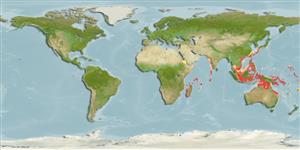
Indo-West Pacific: Maldives. Also reported from New Caledonia (Ref. 11889).
Größe / Gewicht / Alter
Geschlechtsreife: Lm ? range ? - ? cm
Max length : 7.5 cm SL Männchen/unbestimmt; (Ref. 48637)
Kurzbeschreibung
Bestimmungsschlüssel | Morphologie | Morphometrie
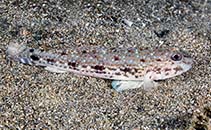
Rückenflossenstacheln (insgesamt) : 6 - 7; Rückenflossenweichstrahlen (insgesamt) : 10; Afterflossenstacheln: 1; Afterflossenweichstrahlen: 10. Characterized by pale grey body color with numerous small white dots and larger brown spots on head and body; row of four large ovate blotches along side at level of pectoral fin base; base of caudal fin with additional spot; united pelvic fins, well developed frenum present; rounded caudal fin, slightly shorter than HL; longitudinal scale series 28-29; ctenoid scales on body and nape; cycloid scales on prepectoral area, breast, cheek and opercle; predorsal scales about 12; 1-2 small spines on preopercular margin just above angle; depth of body 4.2-4.7 in SL (Ref. 90102).
Body shape (shape guide): elongated.
Inhabits coastal sand and mud flats, mainly in deepest parts of estuaries and at moderate depth, about 20 meters, in coastal bays (Ref. 48637).
Lebenszyklus und Paarungsverhalten
Geschlechtsreife | Fortpflanzung | Ablaichen | Eier | Fruchtbarkeit | Larven
Randall, J.E. and M. Goren, 1993. A review of the gobioid fishes of the Maldives. Ichthyol. Bull. J.L.B. Smith Inst. Ichthyol. (58):1-37, 5 pls. (Ref. 9360)
IUCN Rote Liste Status (Ref. 130435: Version 2025-2 (Global))
Bedrohung für Menschen
Harmless
Nutzung durch Menschen
Tools
Zusatzinformationen
Download XML
Internet Quellen
Schätzungen auf der Grundlage von Modellen
Bevorzugte Temperatur (Ref.
123201): 25 - 29, mean 28 °C (based on 866 cells).
Phylogenetischer Diversitätsindex (Ref.
82804): PD
50 = 0.7500 [Uniqueness, from 0.5 = low to 2.0 = high].
Bayesian length-weight: a=0.00741 (0.00347 - 0.01582), b=3.09 (2.91 - 3.27), in cm total length, based on LWR estimates for this (Sub)family-body shape (Ref.
93245).
Trophische Ebene (Ref.
69278): 3.3 ±0.4 se; based on size and trophs of closest relatives
Widerstandsfähigkeit (Ref.
120179): hoch, Verdopplung der Population dauert weniger als 15 Monate. (Preliminary K or Fecundity.).
Anfälligkeit der Fischerei (Ref.
59153): Low vulnerability (10 of 100).
🛈
Nährstoffe (Ref.
124155): Calcium = 154 [68, 299] mg/100g; Iron = 0.817 [0.398, 1.595] mg/100g; Protein = 17.8 [15.8, 19.5] %; Omega3 = 0.106 [0.045, 0.206] g/100g; Selenium = 28.3 [12.6, 66.3] μg/100g; VitaminA = 141 [37, 513] μg/100g; Zinc = 2.19 [1.40, 3.30] mg/100g (wet weight);