>
Siluriformes (Catfishes) >
Ariidae (Sea catfishes) > Ariinae
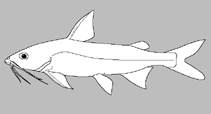
Etymology: Paracinetodus: Derived from the Greek ‘para’ for ‘near’, highlighting its morphological similarity with the genus Cinetodus.
More on author: Weber.
Entorno: milieu / zona climática / rango de profundidad / gama de distribución
Ecología
; agua dulce bentopelágico. Tropical; 4°S - 9°S
Asia and Oceania: thus far known from the Fly and Lorentz rivers in New Guinea, but probably more widespread.
Tamaño / Peso / Edad
Madurez: Lm ? range ? - ? cm
Max length : 40.0 cm SL macho / no sexado; (Ref. 2847)
Espinas dorsales (total) : 1; Radios blandos dorsales (total) : 7; Espinas anales: 0; Radios blandos anales: 15 - 18.
Found in rivers. Feeds on aquatic and terrestrial insects and their larvae, prawns and detritus.
Ciclo vital y comportamiento de apareamiento
Madurez | Reproducción | Puesta | Huevos | Fecundidad | Larva
Allen, G.R., 1991. Field guide to the freshwater fishes of New Guinea. Publication, no. 9. 268 p. Christensen Research Institute, Madang, Papua New Guinea. (Ref. 2847)
Situación en la Lista Roja de la UICN (Ref. 130435: Version 2025-2 (Global))
Amenaza para el ser humano
Traumatogenic (Ref. 58010)
Usos humanos
Herramientas
Informes especiales
Descargar XML
Fuentes de Internet
Estimaciones basadas en modelos
Índice de diversidad filogenética (Referencia
82804): PD
50 = 1.0000 [Uniqueness, from 0.5 = low to 2.0 = high].
Bayesian length-weight: a=0.00468 (0.00245 - 0.00892), b=3.13 (2.96 - 3.30), in cm total length, based on LWR estimates for this (Sub)family-body shape (Ref.
93245).
Nivel trófico (Referencia
69278): 3.1 ±0.41 se; based on food items.
Resiliencia (Referencia
120179): Medio, población duplicada en un tiempo mínimo de 1.4-4.4 años (Preliminary K or Fecundity.).
Vulnerabilidad pesquera (Ref.
59153): Moderate vulnerability (39 of 100).
🛈