Élasmobranches (requins et raies) (sharks and rays) >
Torpediniformes (Electric rays) >
Torpedinidae (Electric rays)
Eponymy: Leopoldo Nobili (1784–1835) was an Italian physicist who studied animal electricity and invented a number of instruments used in thermodynamics and electrochemistry. [...] (Ref. 128868), visit book page.
More on author: Bonaparte.
Environnement : milieu / zone climatique / profondeur / gamme de distribution
Écologie
marin benthopélagique; océanodrome; profondeur 2 - 800 m (Ref. 35509), usually 10 - 150 m (Ref. 35388). Subtropical; 60°N - 48°S, 180°W - 180°E (Ref. 114953)
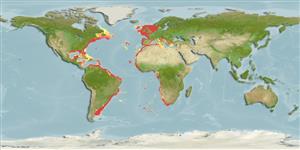
Circumglobal. Eastern Atlantic: Scotland (rare in North Sea) to Morocco, whole of Mediterranean, but not Black Sea; Cap Blanc in Mauritania to Gulf of Guinea, São Tomé Island; Walvis Bay, Namibia to Mossel Bay, South Africa (Ref. 5578). Western Atlantic: Nova Scotia, Canada south to Brazil (Ref. 26340). Eastern Indian Ocean: Australia (Ref. 114953). Southwest Pacific: New Zealand (Ref. 114953).
Taille / Poids / Âge
Maturité: Lm ? range ? - ? cm
Max length : 180 cm TL mâle / non sexé; (Ref. 2803); common length : 40.0 cm TL mâle / non sexé; (Ref. 3261); poids max. publié: 90.0 kg (Ref. 7251)
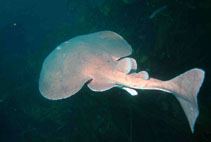
Large ray with a huge, paddle-shaped caudal fin and with no papillae around spiracles. Shiny black or dark grey above, underside white (Ref. 5578). Broad subcircular disc, short snout anterior to the eyes. Smooth skin, short thick tail (Ref. 6902). Dark chocolate to purplish brown above, without spots, white below, but with edges of disc and pelvic fins of same hue as upper surface, tail with irregular dark margins (Ref. 6902).
Body shape (shape guide): other.
Juveniles benthic over soft bottoms or near coral reefs (Ref. 12951) from 10-150 m; adults are semi-pelagic to pelagic, swimming in the water column and have been reported to migrate over long distances (Ref. 2803). Found on insular slopes to at least 925 m depth (Ref. 114953). Feeds mainly on pelagic and benthic bony fishes and small sharks (Ref. 5578). Ovoviviparous (Ref. 50449). Produces litters of up to 60 pups. In South Pacific region, males reaches maturity at ca. 60 cm TL (Ref. 114953). Packs a powerful electric shock of up to 220 volts (Ref. 9710).
Cycle de vie et comportement reproducteur
Maturité | Reproduction | Frai | Œufs | Fécondité | Larves
Exhibit ovoviparity (aplacental viviparity), with embryos feeding initially on yolk, then receiving additional nourishment from the mother by indirect absorption of uterine fluid enriched with mucus, fat or protein through specialised structures (Ref. 50449). With up to 60 in a litter. Gestation period one year (Ref. 12951). Size at birth about 23 cm (Ref. 12951).
Stehmann, M. and D.L. Bürkel, 1984. Torpedinidae. p. 159-162. In P.J.P. Whitehead, M.-L. Bauchot, J.-C. Hureau, J. Nielsen and E. Tortonese (eds.) Fishes of the north-eastern Atlantic and Mediterranean. UNESCO, Paris. Vol. 1. (Ref. 2803)
Statut dans la liste rouge de l'IUCN (Ref. 130435: Version 2025-2 (Global))
Utilisations par l'homme
Pêcheries: sans intérêt; pêche sportive: oui
Outils
Articles particuliers
Télécharger en XML
Sources Internet
Estimations basées sur des modèles
Température préférée (Réf.
123201): 7.3 - 27.5, mean 13.9 °C (based on 3020 cells).
Indice de diversité phylogénétique (Réf.
82804): PD
50 = 0.5001 [Uniqueness, from 0.5 = low to 2.0 = high].
Bayesian length-weight: a=0.01413 (0.01076 - 0.01855), b=2.98 (2.90 - 3.06), in cm total length, based on LWR estimates for this species (Ref.
93245).
Niveau trophique (Réf.
69278): 4.5 ±0.6 se; based on diet studies.
Résilience (Réf.
120179): Faible, temps minimum de doublement de population : 4,5 à 14 années (Fec=60;).
Vulnérabilité de la pêche (Ref.
59153): Very high vulnerability (90 of 100).
🛈
Nutriments (Ref.
124155): Calcium = 4.55 [0.56, 83.64] mg/100g; Iron = 0.469 [0.043, 5.703] mg/100g; Protein = 16.5 [12.3, 20.1] %; Omega3 = 0.287 [0.104, 0.796] g/100g; Selenium = 43.8 [7.7, 218.9] μg/100g; VitaminA = 10.9 [0.8, 145.9] μg/100g; Zinc = 0.386 [0.021, 4.499] mg/100g (wet weight);