Elasmobranchii (tubarões e raias) (sharks and rays) >
Myliobatiformes (Stingrays) >
Mobulidae (Devilrays)
Etymology: eregoodoo: According to Russell (1803), derived from a vernacular name used in the region of Coromandel (south-east India), designating a mobulid ray (Ref. 132274).
Ambiente: milieu / zona climática / intervalo de profundidade / gama de distribuição
Ecologia
marinhas pelagic-oceanic; intervalo de profundidade 0 - 50 m (Ref. 106604). Tropical; 30°N - 21°S
Indo-West Pacific: tropical-subtropical; from the northern Red Sea (26ºN; Egypt) to South Africa (29ºS; Durban); eastward into the Arabian–Persian Gulf, Arabian Sea, Pakistan, southern India, Bangladesh, Malaysia, West and North Australia, to western Pacific, including Sarawak and parts of Indonesia, north to Taiwan (22ºN; Kaohsiung), western Papua New Guinea, and eastern Australia (26ºS; New South Wales).
Tamanho / Peso / Idade
Maturidade: Lm ? range ? - ? cm
Max length : 123 cm WD macho/indeterminado; (Ref. 132274); 130.0 cm WD (female)
Descrição breve
Chaves de identificação | Morfologia | Morfometria
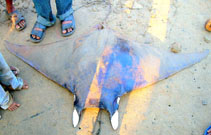
This small mobulid is distinguished by the following characters: pectoral fins very short and with one of the lowest aspect ratios of the genus (i.e. the ratio of DW to disc length, 1:0.578, n = 50), with high relative values of longitudinal metrics (e.g. disc length and anterior projection); head and cephalic fins very elongated with tip of cephalic fin to spiracle 16.5% of DW (n = 50); pre-oral length 5.9% of DW (n = 50); no caudal spine; base of tail quadrangular in section; spiracle very small, subcircular, ventral to plane of pectoral fins; a distinct dark blotch on ventral side of pectoral fins at the midpoint along the leading edge; branchial filter plates distinctively reduced, with four (rarely five) lateral lobes; terminal lobe also distinctively elongated and leaf shaped, pointed terminal lobe (its length almost one-quarter of the plate); colour of plates whitish pink; tooth bands on average 73% of mouth width; most teeth in adult males with multiple long lingual cusps (Ref. 132274).
Cross section: oval.
Found in coastal and oceanic waters (Ref. 30573); solitary or aggregations, sometimes with 50 or more individuals (Ref. 90102). Not known to penetrate the epipelagic zone (Ref. 9911). Ovoviviparous (Ref. 50449).
Ciclo de vida e comportamento de acasalamento
Maturidade | Reprodução | Desova | Ovos | Fecundidade | Larvas
Exhibit ovoviparity (aplacental viviparity), with embryos feeding initially on yolk, then receiving additional nourishment from the mother by indirect absorption of uterine fluid enriched with mucus, fat or protein through specialised structures (Ref. 50449).
Notarbartolo di Sciara, G., S. Adnet, M. Bennett, M.K. Broadhurst, D. Fernando, R.W. Jabado, B.J.L. Laglbauer and G.
Jabado, R. ( Stevens, 2019. Taxonomic status, biological notes, and conservation of the longhorned pygmy devil ray Mobula eregoodoo Cantor, 1849). Aquatic Conserv: Mar Freshw Ecosyst. 2019;1-19. (Ref. 132274)
Categoria na Lista Vermelha da IUCN (Ref. 130435: Version 2025-2 (Global))
Ameaça para o homem
Harmless
Utilização humana
Pescarias: pescarias de subsistência
Ferramentas
Relatórios especiais
Descarregue XML
Fontes da internet
Estimativas baseadas em modelos
Temperatura preferida (Ref.
123201): 25.6 - 29.1, mean 28.2 °C (based on 2136 cells).
Índice de diversidade filogenética (Ref.
82804): PD
50 = 0.5020 [Uniqueness, from 0.5 = low to 2.0 = high].
Bayesian length-weight: a=0.01000 (0.00244 - 0.04107), b=3.04 (2.81 - 3.27), in cm total length, based on all LWR estimates for this body shape (Ref.
93245).
Nível Trófico (Ref.
69278): 3.4 ±0.45 se; based on food items.
Resiliência (Ref.
120179): Baixo, tempo mínimo de duplicação da população 4,5 - 14 anos (Fec assumed to be <100).
Vulnerabilidade da pesca (Ref.
59153): Very high vulnerability (83 of 100).
🛈
Nutrientes (Ref.
124155): Calcium = 26.5 [7.6, 139.1] mg/100g; Iron = 0.962 [0.235, 2.819] mg/100g; Protein = 21 [16, 26] %; Omega3 = 0.184 [0.050, 0.609] g/100g; Selenium = 50.2 [13.3, 160.3] μg/100g; VitaminA = 23.1 [7.7, 73.7] μg/100g; Zinc = 0.942 [0.449, 1.798] mg/100g (wet weight);