Classification / Noms
Noms communs | Synonymes | Catalog of Fishes(Genre, Espèce) | ITIS | CoL | WoRMS | Cloffa
Élasmobranches (requins et raies) (sharks and rays) >
Rajiformes (Skates and rays) >
Rajidae (Skates)
Etymology: Caliraja: The prefix name Cali- refers to the state of California, United States and Gulf of California, Baja California, Mexico, the regions where the types of all four recognized species were described; rhina: Name from the Greek 'rhina' meaning nose (Ref. 27436).
More on authors: Jordan & Gilbert.
Environnement : milieu / zone climatique / profondeur / gamme de distribution
Écologie
marin bathydémersal; océanodrome (Ref. 138310); profondeur 9 - 1069 m (Ref. 80796), usually 55 - 350 m (Ref. 43939). Deep-water; 61°N - 22°N, 165°W - 110°W (Ref. 55282)
Eastern Pacific: Navarin Canyon in the Bering Sea and Unalaska Island, Alaska to Cedros Island, Baja California, Mexico.
Longueur à la première maturité / Taille / Poids / Âge
Maturité: Lm 90.0, range 70 - 100 cm
Max length : 180 cm TL mâle / non sexé; (Ref. 96339); âge max. reporté: 13 années (Ref. 27350)
Description synthétique
Clés d'identification | Morphologie | Morphométrie
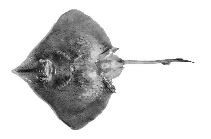
Épines dorsales (Total) : 0; Épines anales: 0. A row of about 20 sharp mid-dorsal spines from base of tail to space between dorsal spines where there may be an additional spine; 1 or 2 mid-dorsal spines immediately behind eyes; a sparse discontinuous row of spines around inner edge of orbit (Ref. 6885). Dorsal fins small and well back on tail; caudal reduced to a low ridge; anal fin absent; pectorals broad, attached to snout and incorporated with body; pelvic fins acutely and very deeply incised (Ref. 6885). A fleshy lateral ridge on each side of tail (Ref. 6885). Dorsal surface uniform brown with a simple dark ring at the base of each pectoral fin, and there may be a light spot posterior to the ring; the ventral surface is a muddy blue with small brown flecks on the anterior part (Ref. 6885).
Body shape (shape guide): other.
Found partially or completely buried on sand and silty bottoms (Ref. 27436). Adults feed mainly on bony fishes (Ref. 114953). Oviparous. Distinct pairing with embrace. Young may tend to follow large objects, such as their mother (Ref. 205). Eggs are oblong capsules with stiff pointed horns at the corners deposited in sandy or muddy flats (Ref. 205). Egg capsules are 9.4-13.0 cm long and 5.7-7.7 cm wide (Ref. 41249, 41300, 41357). Males reaches maturity at ca. 62-74 cm TL, females at 70-100 cm TL; young hatch at 12-17 cm TL (Ref. 114953).
Cycle de vie et comportement reproducteur
Maturité | Reproduction | Frai | Œufs | Fécondité | Larves
Oviparous, paired eggs are laid. Embryos feed solely on yolk (Ref. 50449). Distinct pairing with embrace. Young may tend to follow large objects, such as their mother (Ref. 205). Egg cases usually with only one egg (Ref. 6885).
McEachran, J.D. and K.A. Dunn, 1998. Phylogenetic analysis of skates, a morphologically conservative clade of elasmobranchs (Chondrichthyes: Rajidae). Copeia 1998(2):271-290. (Ref. 27314)
Statut dans la liste rouge de l'IUCN (Ref. 130435: Version 2025-2 (Global))
Menace pour l'homme
Harmless
Utilisations par l'homme
Pêcheries: intérêt commercial mineur
Outils
Articles particuliers
Télécharger en XML
Sources Internet
Estimations basées sur des modèles
Température préférée (Réf.
123201): 3.4 - 8.6, mean 5.8 °C (based on 252 cells).
Indice de diversité phylogénétique (Réf.
82804): PD
50 = 0.5625 [Uniqueness, from 0.5 = low to 2.0 = high].
Bayesian length-weight: a=0.00302 (0.00141 - 0.00645), b=3.24 (3.07 - 3.41), in cm total length, based on LWR estimates for this (Sub)family-body shape (Ref.
93245).
Niveau trophique (Réf.
69278): 3.9 ±0.0 se; based on diet studies.
Résilience (Réf.
120179): Faible, temps minimum de doublement de population : 4,5 à 14 années (Fec assumed to be <100).
Prior r = 0.11, 95% CL = 0.07 - 0.16, Based on 1 full stock assessment.
Vulnérabilité de la pêche (Ref.
59153): Very high vulnerability (78 of 100).
🛈
Nutriments (Ref.
124155): Calcium = 4.71 [0.90, 24.47] mg/100g; Iron = 0.301 [0.072, 0.951] mg/100g; Protein = 16.5 [13.9, 19.1] %; Omega3 = 0.516 [0.128, 1.957] g/100g; Selenium = 17.9 [3.5, 101.2] μg/100g; VitaminA = 9.52 [2.09, 43.20] μg/100g; Zinc = 0.236 [0.115, 0.439] mg/100g (wet weight); based on
nutrient studies.