Elasmobranchii (haaien en roggen) (sharks and rays) >
Myliobatiformes (Stingrays) >
Gymnuridae (Butterfly rays)
Etymology: Gymnura: Greek, gymnos = naked + Greek, oura = tail (Ref. 45335).
More on author: Linnaeus.
Milieu: milieu / Klimaatzone / Diepte / verspreidingsgebied
Ecologie
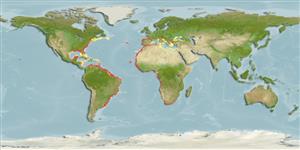
marien; brak water demersaal; diepte 5 - 100 m (Ref. 6808). Subtropical; 47°N - 39°S, 98°W - 42°E
Western Atlantic: southern New England, USA, Brazil (Ref. 7251) to Argentina (Ref. 58839). Eastern Atlantic: Portugal to Ambriz, Angola (including the Mediterranean, Black Sea, and the Madeira and Canary islands).
Grootte / Gewicht / Leeftijd
Maturiteit: Lm ? range ? - ? cm
Max length : 400 cm WD mannelijk / geslacht onbekend; (Ref. 3709); common length : 200 cm WD mannelijk / geslacht onbekend; (Ref. 3709); max. gepubliceerd gewicht: 60.0 kg (Ref. 4699)
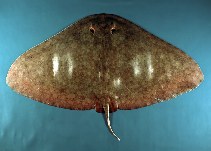
Tail short armed with spine. Disk very broad. Very low dorsal and ventral finfolds on tail (Ref. 7251). Disk dark brown to grayish, lower surface of disc and of pelvic fins white, brownish, rosy or rusty cast. Tail white or rosy white below (Ref. 6902).
Body shape (shape guide): other.
Maximum length measured is 140 cm (Ref. 5377). Occurs over sand and mud. Feeds on fishes, crustaceans, mollusks and plankton. Ovoviviparous, gestation lasting about 6 months with 4 to 7 embryos produced per female (Ref. 6676).
Exhibit ovoviparity (aplacental viviparity), with embryos feeding initially on yolk, then receiving additional nourishment from the mother by indirect absorption of uterine fluid enriched with mucus, fat or protein through specialised structures (Ref. 50449). Distinct pairing with embrace (Ref. 205).
Bauchot, M.-L., 1987. Raies et autres batoides. p. 845-886. In W. Fischer, M.L. Bauchot and M. Schneider (eds.) Fiches FAO d'identificationpour les besoins de la pêche. (rev. 1). Mèditerranée et mer Noire. Zone de pêche 37. Vol. II. Commission des Communautés Européennes and FAO, Rome. (Ref. 3261)
Status op de Rode Lijst van het IUCN (Ref. 130435: Version 2025-2 (Global))
Gevaar voor de mens
Harmless
Gebruik door de mens
Visserij: van minder commercieel belang; sportvis: ja
Tools
Speciale rapporten
Download XML
Internetbronnen
Schattingen op basis van modellen
Gewenste temperatuur (Ref.
123201): 14.9 - 27.8, mean 23.6 °C (based on 860 cells).
Fylogenetische diversiteitsindex (Ref.
82804): PD
50 = 0.5000 [Uniqueness, from 0.5 = low to 2.0 = high].
Bayesian length-weight: a=0.01445 (0.00888 - 0.02353), b=3.09 (2.94 - 3.24), in cm total length, based on LWR estimates for this species & (Sub)family-body (Ref.
93245).
Trofisch niveau (Ref.
69278): 4.5 ±0.1 se; based on diet studies.
Weerstandsvermogen (Ref.
120179): Zeer laag, minimale populatieverdubbelingstijd meer dan 14 jaar (Fec 4-7).
Kwetsbaarheid van de visserij (Ref.
59153): Moderate vulnerability (43 of 100).
🛈
Kwetsbaarheid voor het klimaat (Ref.
125649): High vulnerability (60 of 100).
🛈
Voedingsstoffen (Ref.
124155): Calcium = 10.2 [1.9, 47.1] mg/100g; Iron = 0.577 [0.144, 1.583] mg/100g; Protein = 23.6 [20.2, 26.5] %; Omega3 = 0.252 [0.073, 0.785] g/100g; Selenium = 28.7 [8.6, 87.8] μg/100g; VitaminA = 3.86 [1.23, 11.42] μg/100g; Zinc = 0.398 [0.197, 0.731] mg/100g (wet weight);